
Best Crops for Polyhouse Farming in India: Profit, Season & Crop Selection
A polyhouse can protect crops from rain, wind and sudden weather changes. It also gives growers better control over irrigation, nutrition, temperature and humidity.
But even a well-designed polyhouse cannot correct one major mistake: choosing the wrong crop.
That is why selecting the best crops for polyhouse farming in India should not begin with: “Which crop has the highest price?”
Start with a more important question: Who will buy my crop?
Once you understand the market, look at your climate, type of polyhouse, water quality, technical capability, crop duration, production cost and expected harvesting period.
Different types of high-value crops can be grown under a greenhouse or polyhouse, including vegetables, flowers, fruits and herbs.
Vegetables
Colored capsicum, seedless cucumber, tomato, broccoli and lettuce
Flowers
Gerbera, Dutch rose and carnation
Fruits
Muskmelon, watermelon and strawberry
Herbs
Basil and parsley
All of these crops can have commercial potential. But that does not mean every crop is suitable for every farmer, every location or every polyhouse.
How to Choose the Best Crop for Polyhouse Farming
Seeing another farmer succeed with a crop can be useful. Copying the same crop without understanding why it worked can be risky.
Two farmers can have the same size polyhouse and still require completely different crop plans.
Before selecting a crop, check:
- Temperature and humidity in your location
- Type of polyhouse and available climate management
- Availability and quality of irrigation water
- Crop duration
- Expected harvesting period
- Technical knowledge required
- Availability and cost of labour
- Nearby mandi and wholesale demand
- Access to retailers, supermarkets, hotels and restaurants
- Access to florists or flower markets for floriculture crops
- Expected marketable yield rather than total harvested yield alone
- Likely average selling price during the harvesting period
This becomes even more important when planning commercial polyhouse farming, because the crop must support the economics of the entire project.
A high-value crop is not automatically a high-profit crop. It makes commercial sense only when you can grow the required quality and sell it consistently.
Quick Polyhouse Crop Selection Guide
Use this table as a starting point. It is not a replacement for a farm-specific crop plan.
| Crop | Crop / Harvest Pattern | Typical Market | Commercial Planning Priority |
|---|---|---|---|
| Colored Capsicum | Long harvesting period | Wholesale, retail and premium vegetable markets | Quality and market timing |
| Seedless Cucumber | Comparatively short crop cycle | Mandi, wholesale and retail | Fast movement of produce |
| Tomato | Regular harvesting | Large general vegetable market | Price fluctuation and crop management |
| Broccoli | Cool-condition crop | Urban and premium food markets | Buyer identification |
| Lettuce | Approximately 45–60 days | Hotels, restaurants, supermarkets and premium retail | Buyer identification before scaling |
| Gerbera | Multi-year crop | Flower markets, florists, hotels and decorators | Flower quality and buyer network |
| Dutch Rose | Multi-year crop | Flower markets and florists | Stem quality and market access |
| Carnation | Cut-flower crop | Flower markets and florists | Climate and buyer network |
| Strawberry | Seasonal premium fruit | Premium retail and specialised fruit buyers | Quality, handling and quick sales |
| Basil & Parsley | Repeated harvesting | Hotels, restaurants and specialised buyers | Confirmed demand |
1. Colored Capsicum
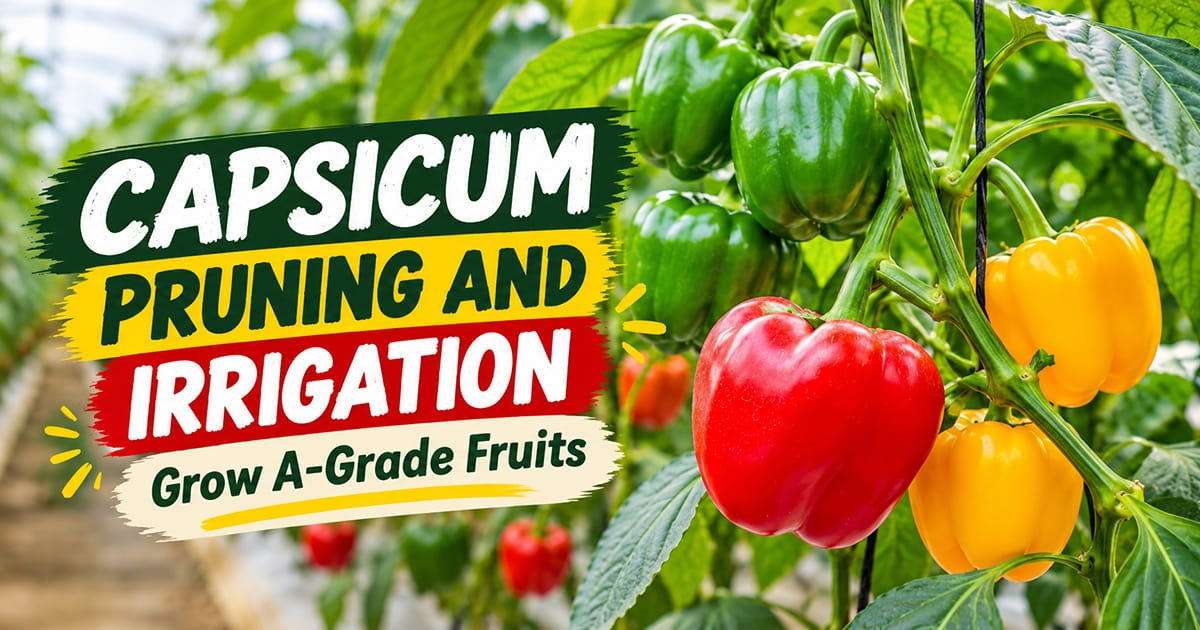
Colored capsicum is one of the most recognised commercial crops in Indian polyhouse farming.
Red, yellow and orange bell peppers generally serve a premium market compared with ordinary green capsicum. However, achieving the required fruit size, colour, shape and quality needs careful crop management.
Indicative Growing Conditions:
Temperature: 18°C–35°C
Relative humidity: 50%–70%
Light intensity: approximately 55,000–65,000 lux
One important advantage is the harvesting period. Under polyhouse conditions, plants can continue producing for around 7–9 months.

Each plant can produce an average of approximately 2.5–3 kg of marketable colored capsicum, with expected production around 25–30 tonnes per acre.
Indicative prices can range from approximately ₹80–200/kg. Actual prices depend heavily on season, market, quality and supply.
Where it is suitable: Karnataka, Tamil Nadu, Maharashtra and Himachal Pradesh have high suitability. Punjab, Haryana, Uttar Pradesh, Madhya Pradesh and Gujarat are also suitable, while cultivation is expanding in Bihar, Jharkhand, West Bengal, Odisha and Chhattisgarh.
2. Seedless Cucumber
Seedless cucumber deserves serious consideration when relatively fast crop turnover is important.
It is a semi-tropical crop that prefers warm conditions, good light and carefully managed humidity. Its ideal daily average air temperature is around 15–24°C, although cultivation can operate across a broader range depending on crop stage and local conditions.
A typical crop cycle is around 4–5 months.
In soil cultivation, approximately two crops can be taken in a year. Soilless cultivation can have a longer production period under suitable management.
Average production can reach around 4–6 kg per plant, with expected production of approximately 30–40 tonnes per acre per crop cycle.
Important harvesting periods include February to April and October to December.

Cucumber is widely relevant to protected cultivation in Rajasthan, Gujarat, Haryana, Uttar Pradesh, Madhya Pradesh, Bihar, Chhattisgarh and Jharkhand. Its established consumer market is an important commercial advantage, although growers still need to understand local prices and supply patterns before planting.
3. Tomato
Tomato has something many niche polyhouse crops do not: a huge existing consumer market.
Households, restaurants, hotels and food businesses consume tomatoes throughout the year.
The challenge is price.
Open-market tomato prices can move sharply with supply. Rainfall, temperature, pests and diseases can also disturb production.

A polyhouse creates a more manageable growing environment. Tomato performs best at approximately 22–29°C with adequate sunlight.
An indicative production model of 12,000 plants producing an average of 5 kg per plant gives total production around 60,000 kg. Actual production varies with climate, variety and crop management.
Tomatoes are successfully grown in Karnataka, Maharashtra, Andhra Pradesh, Uttar Pradesh, Bihar, Odisha, Madhya Pradesh and West Bengal.
4. Broccoli
Broccoli belongs to a more specialised market.
Demand is stronger in urban and premium food markets than in many traditional vegetable markets. This makes buyer identification especially important.
Broccoli prefers cooler conditions, with an ideal temperature around 15–22°C.
Indicative prices can range around ₹60–150/kg, with stronger prices possible when market supply is lower.

Commercial Tip: Do not select broccoli only because of its selling price. First understand how much broccoli your local market can absorb and what quality buyers expect.
5. Lettuce
Lettuce can work well for farms located near cities, hotels, restaurants, supermarkets and premium fresh-produce buyers.
Its biggest commercial advantage is speed.
Lettuce can be ready for harvest in approximately 45–60 days, allowing multiple crop cycles in a year.
Fresh, clean lettuce can command indicative prices of approximately ₹80–200/kg in premium urban markets.
There is one important catch: lettuce is more specialised than tomato or cucumber. Do not expand production simply because the crop grows well. Confirm that enough buyers exist to absorb the planned volume.

6. Gerbera
A polyhouse does not have to produce vegetables.
For growers with access to a reliable flower market, gerbera can be considered as a serious commercial floriculture crop.

Gerbera is purchased by wholesale flower markets, florists, hotels, wedding decorators and bouquet suppliers.
Flower quality matters enormously.
Temperature: 18–35°C
Relative humidity: approximately 60–70%
Light intensity: approximately 43,000–65,000 lux
A commercial plantation may contain approximately 26,000 plants per acre. Indicative annual production can reach around 7,36,000 stems, with an average selling price assumption of approximately ₹3.50 per stem.
Harvesting can begin approximately 90 days after planting, while the economic crop life can extend up to four years. This changes the investment decision completely compared with a short-duration vegetable crop.
7. Dutch Rose
Dutch rose is another established commercial flower under protected cultivation.
Buyers look for long stems, attractive colour, uniform flowers and good vase life. This makes both crop management and the growing environment important.

Dutch roses perform best at approximately 18–32°C, with relative humidity around 50–60%.
A commercial plantation can have approximately 30,000 plants per acre.
Indicative production is around 5,70,000 stems, based on approximately 19 stems per plant annually, with an indicative average selling price around ₹5.50 per stem.
Dutch rose cultivation is well established in Karnataka, Tamil Nadu, Maharashtra and Himachal Pradesh. Commercial cultivation is also possible in Haryana, Punjab, Uttar Pradesh, Madhya Pradesh, Gujarat, Rajasthan, Bihar, West Bengal, Odisha and Chhattisgarh when the polyhouse, irrigation and crop-management systems are suitable.
8. Carnation
Carnation is a premium cut flower suited to protected cultivation where temperature can be managed properly.
The crop prefers temperatures around 15–22°C.
Polyhouse cultivation supports better-quality stems and can enable an extended flowering period when crop conditions are maintained correctly.
Indicative prices can range from approximately ₹3–12 per stem, depending on variety and season.
As with gerbera and Dutch rose, production is only half of the commercial equation. You also need access to buyers who can regularly purchase quality flowers.

9. Muskmelon
Fruit quality in muskmelon is closely linked to growing conditions.
Controlled irrigation, warm conditions and lower humidity during ripening can help develop sweetness, aroma and attractive fruit quality. Protection from rain is another important advantage.
The commercial opportunity becomes particularly interesting when growers can produce quality fruit during periods of limited premium supply. Muskmelon can therefore be evaluated as part of an off-season production strategy rather than simply another summer fruit crop.

10. Watermelon
Watermelon already has huge consumer demand in India.
Timing is the challenge.
Heavy peak-season supply can put strong pressure on prices. Protected cultivation can support earlier or off-season production and help growers target periods when market supply is lower.
Indicative off-season prices can reach around ₹30–60/kg, compared with approximately ₹5–10/kg during periods of heavy summer supply.
These are market-dependent figures and should not be considered guaranteed selling prices.

11. Strawberry
Strawberry sits firmly in the premium-fruit category.
Indicative market prices can reach approximately ₹200–500/kg.
That headline price can make the crop look extremely attractive. It should not be the only reason you plant it.
Strawberries require careful production, harvesting, handling and marketing. Fresh fruit also needs to reach the buyer quickly. A grower should therefore understand local demand, expected quality and sales logistics before selecting strawberry commercially.

12. Basil
Basil offers a very different opportunity from conventional polyhouse vegetables.
Demand can come from culinary, medicinal and essential-oil markets. The required crop and variety should match the intended buyer.

The first harvest can begin in approximately 30–40 days, followed by re-harvesting every 15–20 days under suitable conditions.
Basil is sensitive to frost, so protected cultivation can also support production during colder periods. Before planting at scale, know exactly which market you intend to supply.
13. Parsley
Parsley remains relatively specialised in India, but restaurants, hotels and international food businesses create a potential market.
Both flat-leaf or Italian parsley and curly parsley are used in professional kitchens.
Its cut-and-come-again harvesting allows repeated harvests from a single planting.
Location matters enormously.
A farm supplying restaurants and hotels near a large city can have a completely different commercial opportunity from a farm depending entirely on a traditional vegetable mandi.

Important Disclaimer: Crop performance, yield, harvesting period and selling price can vary depending on location, season, variety, weather, water quality, crop management, market conditions and several other factors. The production and price figures mentioned in this article are indicative only and should not be considered guaranteed yield, income or profit. Always evaluate your local growing conditions and market demand before making a commercial crop decision.
Which Polyhouse Crop Is Better for a First-Time Grower?
New growers often want one crop name.
There is no single answer that works everywhere.
A first-time grower should consider crop complexity alongside potential income.
Ask practical questions:
- How frequently will the crop need harvesting?
- Does it require regular pruning or training?
- How sensitive is it to temperature and humidity?
- How quickly must harvested produce reach the market?
- Is skilled labour available?
- Can you get technical support when something goes wrong?
A crop with an established local market and a manageable production cycle may make more commercial sense for a new grower than a specialised crop carrying an impressive market price.
Before making that decision, growers can also review actual protected farming success stories to understand how other farmers approached commercial cultivation.
Which Polyhouse Crop Is Best for Commercial Farming?
There is no single “most profitable polyhouse crop” for every farmer in India.
Colored capsicum can be considered when an established premium vegetable market is accessible.
Seedless cucumber deserves attention when comparatively faster crop turnover is important.
Tomato provides access to a broad consumer market, although market-price fluctuations must be considered.
Lettuce and broccoli are more closely linked to premium and urban buyers.
For commercial floriculture, gerbera, Dutch rose and carnation can be considered where reliable flower-market access exists.
Muskmelon, watermelon and strawberry create opportunities in fruit production, while basil and parsley serve more specialised markets.
The right crop is the one where production capability and market opportunity meet.
One Acre Does Not Mean One Crop Is Right Everywhere
Imagine three farmers each planning a one-acre polyhouse.
One is near Bengaluru. One is near Lucknow. Another is close to Delhi.
The structure area may be similar, but their crop plans should not automatically be the same.
Local temperature, humidity, water quality, labour availability, transport distance, nearby markets and buyer networks can all be different.
A grower close to a strong hotel and restaurant market may evaluate lettuce or herbs differently from someone whose main sales channel is a traditional mandi.
A farmer with direct access to a flower market has another set of options.
The polyhouse may be the same size, but the crop strategy should not be the same.
Start With the Buyer, Then Work Backwards
Many crop plans follow this sequence:
Select Crop → Plant → Grow → Harvest → Search for Buyer
Commercial planning should ideally work in the opposite direction:
Buyer → Required Quality → Required Harvest Window → Crop → Variety → Planting Date → Production Plan
Visit your nearby mandi.
Speak to wholesalers.
Check whether hotels, restaurants, supermarkets, florists or specialised fresh-produce buyers operate within a practical delivery distance.
Ask what they actually purchase. Find out what quality they expect, how much they normally buy and when supply becomes difficult.
Then build the crop plan.
This is especially important for specialised produce. A cucumber grower can access a very different market from a parsley grower. Gerbera needs flower buyers. Strawberry needs buyers willing to pay for premium fresh fruit.
The crop and sales channel must work together.
Farmers researching their options can also use the AgriFirst farming resources and blogs before finalising a commercial plan.
₹200/kg Selling Price Does Not Mean ₹200/kg Profit
This distinction matters.
A farmer may hear that a particular crop sold for ₹200/kg in a market and immediately calculate the complete project using ₹200/kg.
That can create a misleading picture.
The highest observed market price is not necessarily the farmer's average selling price across the complete harvesting period.
Basic Revenue Calculation
Revenue = Marketable Yield × Actual Average Selling Price
Basic Profit Calculation
Profit = Revenue − Complete Cost of Production
The cost side can include planting material, fertilisers, crop-protection inputs, labour, electricity, packaging, transportation and other operating expenses relevant to the farm.
There can also be produce that does not meet the preferred market grade.
Run the numbers using conservative assumptions rather than the best price somebody received on one particular day.
Growers evaluating the initial infrastructure side can use the AgriFirst Polyhouse Investment Calculator as a starting point for understanding project investment.
The AgriFirst 7-Point Crop Test
Before finalising any crop for commercial polyhouse farming, try to answer these seven questions clearly.
1. Climate
Can the required growing conditions be maintained in your location and structure?
2. Water
Do you have adequate irrigation water, and is its quality suitable for the planned crop?
3. Structure
Is the proposed polyhouse and its climate-management capability appropriate for that crop?
4. Skill
Do you and your team understand the crop, or will suitable technical guidance be available throughout the crop cycle?
5. Harvest
When will harvesting begin, how long can production continue and how frequently will produce need to be harvested?
6. Buyer
Who will buy the crop, what quality do they need and how will the produce reach them?
7. Numbers
Does the crop still make commercial sense when you calculate revenue using a conservative yield and selling price?
If the buyer question cannot be answered clearly, the crop is not commercially selected yet.
Final Takeaway: Choose the Market Before You Choose the Crop
The best crops for polyhouse farming in India are not simply the crops with the highest selling price. A crop becomes commercially suitable when it matches your growing conditions, management capability and market demand.
Colored capsicum, seedless cucumber and tomato have established vegetable markets. Gerbera, Dutch rose and carnation are important commercial flower crops. Lettuce, broccoli, basil and parsley serve more specialised buyers, while muskmelon, watermelon and strawberry offer opportunities in premium and seasonal fruit markets.
Before finalising a crop, make sure these five factors work together:
| Location & Climate | The crop should suit the growing conditions you can realistically maintain. |
| Water | Reliable water availability and suitable water quality are essential. |
| Polyhouse | The structure and climate-management capability should match the crop. |
| Crop Management | You should have the technical knowledge, labour and support needed to manage the crop properly. |
| Market | There should be a practical market that can buy the required quality and volume consistently. |
This is why crop selection should not begin with the question, “Which crop gives the highest profit?” A better commercial question is:
The Right Question
“Which crop can I grow to the required quality, at the right time, and sell consistently to a market I understand?”
When the crop, growing conditions, production capability and market fit together, the polyhouse has a much stronger commercial foundation. That is what should drive the final crop decision.
Important Note
Climate ranges, production figures, harvesting periods and market prices mentioned in this article are indicative only. Actual results can vary depending on crop variety, location, season, polyhouse design, production system, crop management and market conditions. Commercial cultivation decisions should be made only after evaluating farm-specific technical conditions and local market demand.