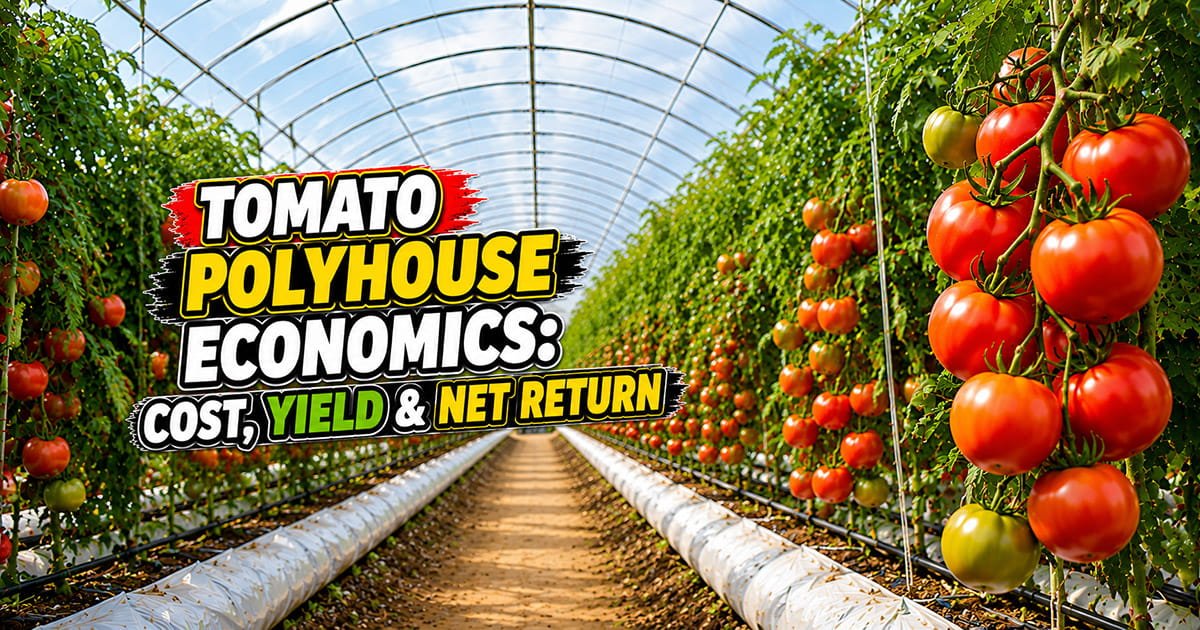
Tomato Polyhouse Economics: Cost, Expenses, Yield & Net Return
Tomato polyhouse farming can be highly profitable when structure, crop care, and market planning are managed properly. In this guide, you will find the exact investment values, operating expenses, production estimate, NHB subsidy support, and net return per acre for one acre of tomato cultivation under protected conditions.
protected cultivation solutions, greenhouse polyhouse structures, and crop options for protected cultivation.
Tomato Polyhouse Farming Economics Summary
| Particular | Value |
|---|---|
| Crop | Tomato |
| Area | 1 Acre |
| Total Production | 60,000 kg |
| Selling Price | ₹25 per kg |
| Gross Return | ₹15,00,000 |
| Operating Cost | ₹5,96,000 |
| Net Return | ₹9,04,000 |
| Polyhouse Cost After Subsidy | ₹30,00,000 |
Why Tomato Polyhouse Farming Has Strong Commercial Potential
Tomato is one of the most widely consumed vegetables in India. Strong demand from households, food service businesses, and processing industries makes it a commercially attractive crop.
In open-field cultivation, tomato production is often affected by rainfall, temperature fluctuations, pests, and disease outbreaks. A polyhouse reduces many of these risks by creating a more stable growing environment. Better temperature control and weather protection help maintain consistent growth and yield.
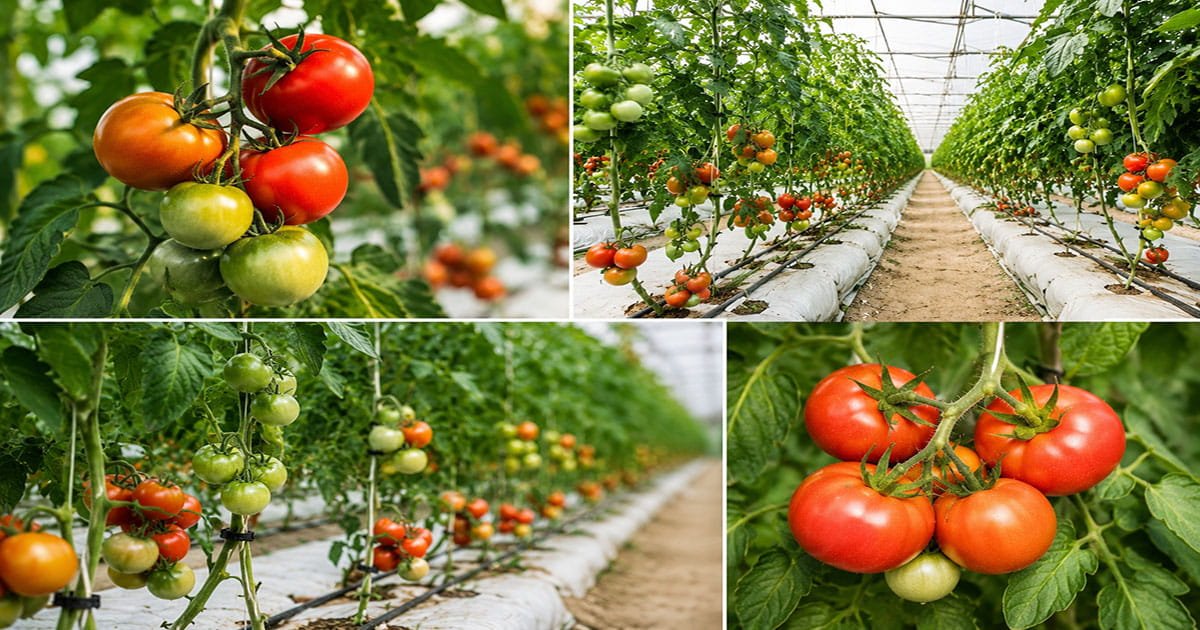
Benefits of Tomato Polyhouse Farming
- Better yield stability compared to open-field tomato cultivation.
- Protection from heavy rainfall, strong winds, and sudden weather changes.
- Improved fruit quality, size uniformity, and market acceptance.
- Lower pest and disease pressure through controlled cultivation.
- More efficient use of water and fertilizers through drip-based management.
- Stronger commercial potential per acre when crop management is disciplined.
Tomato Crop Requirements in Polyhouse Farming
Tomatoes perform best at temperatures between 22 and 29°C with adequate sunlight. A polyhouse helps maintain these conditions more consistently than open-field cultivation, supporting stable growth and fruit development.
Best Practices for Successful Tomato Polyhouse Cultivation
Successful tomato cultivation starts with quality seedlings, proper spacing, trellising, pruning, drip irrigation, and fertigation. Regular crop monitoring helps identify pests, diseases, and nutrient deficiencies early, while timely harvesting improves market quality and shelf life.
Geographic Compatibility for Tomato Cultivation in India
Tomatoes grow successfully in Karnataka, Maharashtra, Andhra Pradesh, Uttar Pradesh, Bihar, Odisha, Madhya Pradesh, and West Bengal. Water availability, labour access, and proper crop management remain important for success under protected cultivation.
Annual Operating Expenses for Tomato Polyhouse Cultivation
Operating cost is one of the most important parts of tomato polyhouse economics because it shows the annual spending required after the structure is in place. The figures below are the exact values provided for one acre.
| Particulars | Amount | Information |
|---|---|---|
| Field Preparation | ₹50,000.00 | FYM, tillage, basal fertilizers, bed making and related work |
| Labour* | ₹2,36,000.00 | Labour cost for crop operations, harvesting and maintenance |
| Seeds & Nursery Cost | ₹40,000.00 | Includes quality seeds and nursery preparation expenses |
| Fertilizers | ₹2,00,000.00 | Water-soluble NPK and micronutrient inputs |
| Pesticides | ₹40,000.00 | Fungicide, insecticide, acaricide and other inputs if required |
| Other Expenses | ₹30,000.00 | Farm expense, electric bill and other operational costs |
| Total Operating Expense | ₹5,96,000.00 | Total annual crop operating cost per acre |
Production Estimate, Gross Return, and Net Return
Under the given assumptions, tomato polyhouse production becomes commercially attractive because the output and selling price support a strong gross return.
| Metric | Value | Notes |
|---|---|---|
| Production per Plant | 5 kg | Production depends on climatic conditions |
| Total Production | 60,000 kg | Based on 12,000 plants with an average production of 5 kg per plant, with avg price of ₹25 per kg |
| Gross Return | ₹15,00,000 | Based on projected production and market realization |
| Net Return | ₹9,04,000 per acre | Prices may vary based on market conditions |
Based on 12,000 plants and an average production of 5 kg per plant, the total production is estimated at 60,000 kg. Assuming an average selling price of ₹25 per kg, the projected gross return is estimated at ₹15,00,000. After considering the annual operating expense of ₹5,96,000, the projected net return is approximately ₹9,04,000 per acre.
Cost of 1 Acre Polyhouse Structure in India
The structure cost is the major investment at the beginning of the project. For a one-acre unit measuring 4080 sq. m., the following cost details are provided.
| Project Particulars | Rate / Status |
|---|---|
| Size of the Unit | 1 Acre (4080 sq. m.) |
| Foundation Pipe | Included |
| Covering Plastic | Included |
| Secondary Layer Shade Net Manual Mechanism | Included |
| Shade Net for Top Vent | Included |
| Insect Net on Four Sides | Included |
| Bottom Skirting on Four Sides | Included |
| Manual Rollup Curtain | Included |
| Double Door Entry System (Aluminium Sliding Door with Buffer Zone) | Included |
| Trellising | Included |
| Structure Installation | Included |
| Ex-factory Price per Sq. Metre | ₹1060 / Sq. Metre |
| Ex-factory Price per Sq. Metre with GST @18% | ₹1250 / Sq. Metre |
| Total Investment Cost without Subsidy | ₹58,00,000* |
| NHB Subsidy | ₹28,00,000* |
| Total Investment Cost with Subsidy | ₹30,00,000* |
The total cost for a one-acre polyhouse structure in India is ₹30,00,000* approximately after subsidy, based on the given information.
NHB Subsidy Support for Tomato Polyhouse Projects
Government support programs play an important role in promoting protected cultivation across India. The subsidy values mentioned in this article are based on the National Horticulture Board (NHB) framework.
Farmers planning tomato cultivation under polyhouse conditions should verify the latest subsidy guidelines, eligibility criteria, and implementation procedures before investing. Assistance may also be available through schemes operating under the Mission for Integrated Development of Horticulture (MIDH).
How to Start Tomato Polyhouse Farming
Starting a tomato polyhouse project requires more than installing a structure. A good project begins with land selection, water planning, budget clarity, and market understanding. The grower should first check land suitability, access to electricity, water quality, and labour availability.
After the structure is ready, attention should move to nursery quality, transplant timing, nutrient scheduling, pruning, pest monitoring, and harvesting discipline. Tomato cultivation requires timely operations. Even a small delay in crop operations can affect fruit quality and harvest window.
Challenges in Tomato Polyhouse Farming
Tomato polyhouse farming offers strong earning potential but requires careful management. The first challenge is the upfront investment, which is large enough to require planning before execution.
Market price variation is another factor that growers must keep in mind. Tomato prices can move quickly, and profit depends on both yield and selling price. Disease control, labour planning, and regular monitoring also matter because protected cultivation improves the environment, but it does not replace farm management.
Tomato Polyhouse Success Story
A Karnataka farmer shifted from open-field tomato cultivation to a one-acre polyhouse after recurring weather-related losses. Through drip irrigation, fertigation, trellising, and regular monitoring, crop quality and yield consistency improved, resulting in better market acceptance and predictable harvesting.
Key Takeaways for Tomato Polyhouse Economics
- Tomato polyhouse farming works best when climate control, crop care, and market planning are managed together.
- The annual operating expense for one acre is ₹5,96,000.00.
- Expected production is 60,000 kg from approximately 12,000 plants with an average production of 5 kg per plant.
- Estimated gross return is ₹15,00,000 and estimated net return is ₹9,04,000 per acre.
- The one-acre polyhouse structure cost after subsidy is approximately ₹30,00,000*.
Improving Annual Returns from Tomato Polyhouse Farming
Tomato cultivation under a polyhouse can provide stable production and better crop protection compared to open-field farming. However, annual profitability depends on yield, market prices, and efficient utilization of the protected structure throughout the year.
To improve overall returns, many growers plan additional crop cycles after tomato harvesting. Crops such as cucumber can be cultivated in the next season to maximize polyhouse utilization, generate additional income, and improve the overall economics of the farming operation.
Conclusion
Tomato polyhouse farming combines yield potential, controlled cultivation, and commercial viability. When the structure is planned correctly, the operating cost is managed carefully, and the crop is grown under the right climate conditions, the financial outcome can be attractive.
For growers who are serious about modern agriculture, this can turn one acre into a scalable business opportunity. With the right structure, crop management, and market approach, tomato polyhouse farming can become a strong long-term income stream.