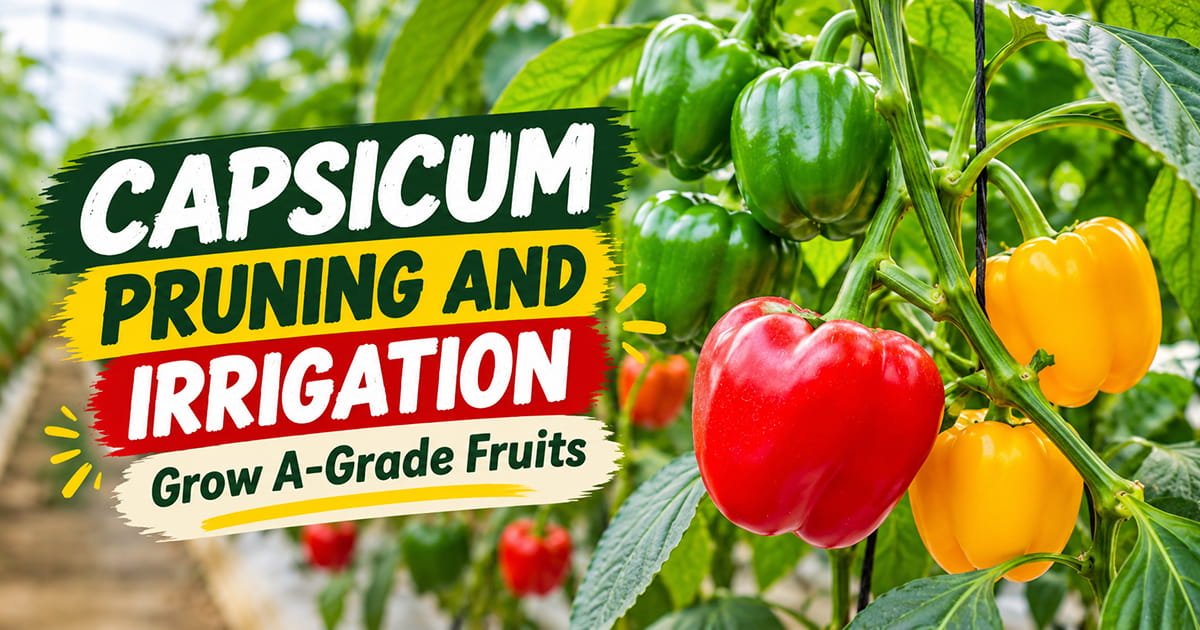
Growing good-quality capsicum in a polyhouse requires attention to more than plant growth and fruit setting. The number of fruits developing on a plant, their size, branch development, and soil moisture all influence the crop's overall quality.
Capsicum pruning and irrigation are two important parts of crop management. Pruning helps maintain plant structure and control fruit load, while irrigation and fertigation help maintain suitable moisture conditions for plant development.
Managing these practices properly can help growers maintain the desired fruit size and support healthy crop development throughout the growing period.
1. Balance Vegetative and Reproductive Growth in Capsicum
Capsicum plants need a balance between vegetative and reproductive growth to develop good-quality fruits.
Vegetative growth includes the development of branches and leaves, while reproductive growth involves flowering and fruiting. Both are necessary, but allowing too many fruits to develop simultaneously can make it difficult to achieve the desired fruit size.
Pruning helps maintain this balance by removing unnecessary side branches and managing the number of developing fruits. This allows growers to maintain a suitable plant structure while focusing on fruit development.
2. Why Maintaining Two Main Branches Matters
One approach to capsicum pruning in polyhouse cultivation involves maintaining two main branches and removing unnecessary side branches.
As the plant grows, additional branches develop along the sides. These branches need to be managed according to the pruning method being followed.
Several flowers may appear on the plant, followed by fruit setting at different points. When too many fruits develop close together, achieving the required fruit size can become difficult.
Maintaining two main branches helps growers manage plant structure and fruit load in this pruning system. Removing unwanted side branches also helps maintain the intended growth pattern.
3. Capsicum Pruning for Better Fruit Size and Quality
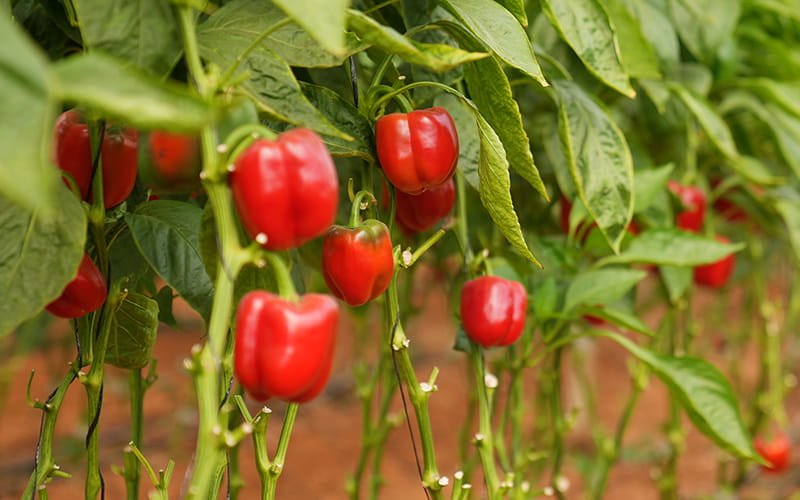
Fruit size is an important consideration when growing capsicum for the market. Depending on market requirements, growers may aim for fruits weighing approximately 200 grams each as a quality target.
Achieving the desired size requires attention to pruning and the number of fruits retained on the plant.
During crop development, flowers and fruits may appear close to one another. If too many developing fruits are retained, they may not reach the intended size.
Proper pruning involves maintaining the selected main branches, removing unnecessary side branches, and managing fruit load as the plant develops.
More fruits on a plant do not necessarily mean better-sized fruits. Growers need to maintain a balance between the number of developing fruits and the size they want to achieve.
4. Importance of Irrigation and Fertigation in Capsicum
Along with pruning, irrigation and fertigation require regular attention during capsicum cultivation.
Irrigation involves supplying water to the crop, while fertigation involves applying fertilizers along with irrigation water.
For soil-grown capsicum, maintaining suitable moisture conditions in the growing beds is important for plant development and nutrient availability.
Before the next fertigation, growers should pay attention to the moisture condition of the soil. Looking only at the surface may not provide a clear understanding of the moisture present in the growing bed.
A simple soil moisture check can help growers assess the condition of the soil before proceeding with fertigation.
5. How to Check Soil Moisture Before Fertigation
One practical way to observe soil moisture is by taking a small amount of soil from the growing bed and forming it into a ball.
Once the soil ball is formed, drop it onto the ground and observe whether it holds together or breaks apart.
For soil with suitable characteristics, a ball that breaks apart after being dropped can indicate a suitable moisture condition for the next fertigation.
However, the way soil holds together or breaks apart depends on its characteristics. The same result may not indicate the same moisture condition in every soil type.
This method can serve as a practical field check, but it should not be treated as a fixed moisture standard for all growing beds.
6. Why Soil Moisture Can Differ Between Growing Beds
Soil moisture may vary between growing beds within the same polyhouse, even when the beds are located close to one another.
One reason for this difference is ventilation. A growing bed exposed to more ventilation may become drier than another bed receiving less airflow.
As a result, one section of the polyhouse may have suitable moisture while another section requires additional attention.
Checking only one growing bed may therefore not provide a complete picture of soil moisture conditions throughout the crop.
Growers should pay particular attention to areas receiving more ventilation and take additional precautions to maintain suitable soil moisture where required.
7. How Soil Moisture Affects Calcium and Capsicum Development
Soil moisture plays an important role in nutrient uptake and plant development. Unsuitable moisture conditions can affect the availability and movement of nutrients, including calcium.
When soil moisture is not maintained properly, calcium uptake and its movement within the capsicum plant may be affected.
Changes in fruit and leaf development may also become noticeable under unsuitable growing conditions. However, differences in fruit or leaf size alone are not enough to confirm calcium deficiency.
Maintaining suitable moisture conditions is therefore important for supporting nutrient uptake and crop development.
Growers should also pay attention to sections of the polyhouse where the soil becomes drier because of increased ventilation.
8. Bringing Pruning and Moisture Management Together
Capsicum pruning and irrigation address different aspects of crop management, but both influence fruit development and quality.
Pruning helps maintain the selected branch structure and manage the number of developing fruits. In a two-main-branch pruning system, unnecessary side branches are removed to maintain the intended plant structure and fruit load.
Irrigation and fertigation focus on supplying water and fertilizers while maintaining suitable soil moisture conditions.
Growers should also consider that moisture levels may differ between growing beds, particularly in areas receiving more ventilation.
Paying attention to both plant growth and soil moisture helps growers manage the crop according to its development and fruit quality requirements.
Conclusion
Producing good-quality capsicum requires proper management of plant growth, fruit load, and soil moisture.
Maintaining two main branches in the appropriate pruning system, removing unnecessary side branches, and managing developing fruits can help growers work towards their desired fruit size.
At the same time, checking soil moisture before fertigation and observing differences between growing beds can support better irrigation management.
Regular attention to capsicum pruning and irrigation helps growers maintain the growing conditions needed for fruit development and quality.
Planning a Polyhouse Farming Project?
Choosing the right polyhouse structure is an important part of planning a protected cultivation project. Explore AgriFirst's greenhouse and polyhouse solutions to learn more about the available structures.
Planning a new project? Contact AgriFirst to discuss your polyhouse requirements.