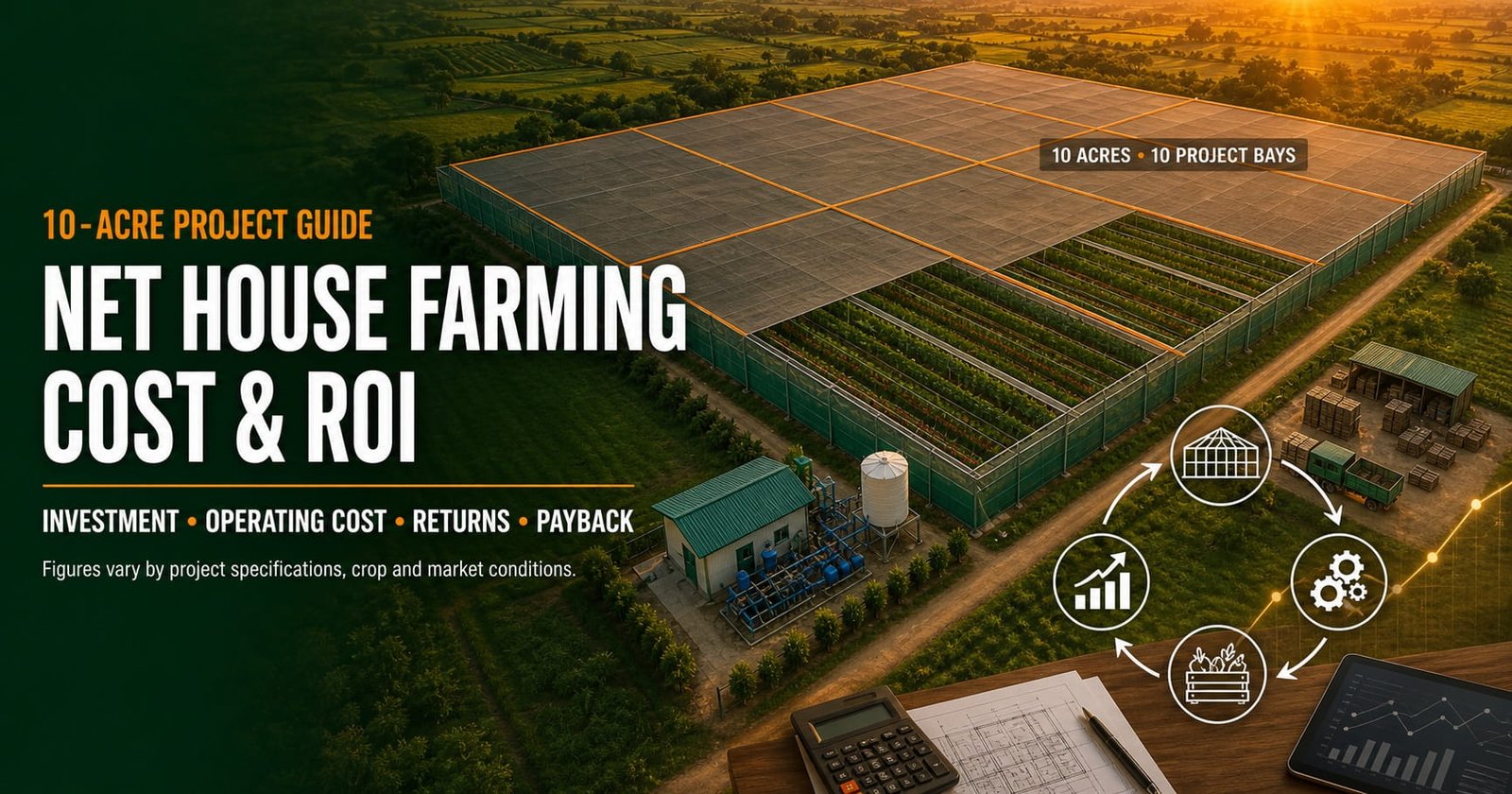
If you are weighing commercial net house farming as an investment, three questions decide everything: what does it cost, what does it return, and how long until you get your money back? This is a transparent, line-by-line breakdown of a 10-acre commercial net house project — investment, operating cost, revenue, net profit, ROI and payback.
One note before the numbers: every figure here is indicative, not guaranteed. Real costs and returns vary with your location, water, crop plan, management quality and — above all — market prices. Treat this as a well-grounded model to pressure-test, not a promise. For the wider picture, see our complete guide to commercial net house farming.
What a commercial net house costs per acre
As an indicative benchmark, a commercial net house costs roughly ₹25 lakh per acre, fully built and ready to crop — the structure and every supporting system, not just the frame and net. It costs less per acre than a polyhouse, which is why it is the faster-payback entry into protected cultivation.
What is included in the project cost
The per-acre cost is made up of several components. Indicative split, per acre:
| Component | Indicative cost / acre |
|---|---|
| Net house structure (GI frame + shade net + drip) | ₹18,00,000 |
| Civil works (foundation, apron) | ₹1,20,000 |
| Accessories (mulch, seed, clips, twine, trays) | ₹3,69,000 |
| Weed-mat (paths + beds) | ₹1,00,000 |
| Miscellaneous | ₹1,00,000 |
| Total per acre | ~₹24,89,000 |
This covers the structure plus the growing system and crop establishment. It assumes the land is your own, and working capital for the first crop cycle is a separate requirement (covered below).
Total investment for 10 acres
Scaling to a full 10-acre commercial project:
| Component | Indicative cost (10 acres) |
|---|---|
| Net house structure | ₹1.80 crore |
| Civil works | ₹12.00 lakh |
| Accessories | ₹36.93 lakh |
| Weed-mat | ₹10.00 lakh |
| Miscellaneous | ₹10.00 lakh |
| Total capital investment | ~₹2.49 crore |
Operating expenses (OPEX)
Beyond the one-time build, each crop cycle has running costs — seedlings, field preparation, fertilizers, crop protection, labour and miscellaneous. For the full 10-acre double-crop year, indicative OPEX is about ₹64.7 lakh:
| Crop (area) | Indicative OPEX / year |
|---|---|
| Cucumber — summer, all 10 acres | ₹31.40 lakh |
| Tomato — winter, 5 acres | ₹16.65 lakh |
| Capsicum — winter, 5 acres | ₹16.65 lakh |
| Total annual OPEX | ~₹64.70 lakh |
Crop revenue versus net profit
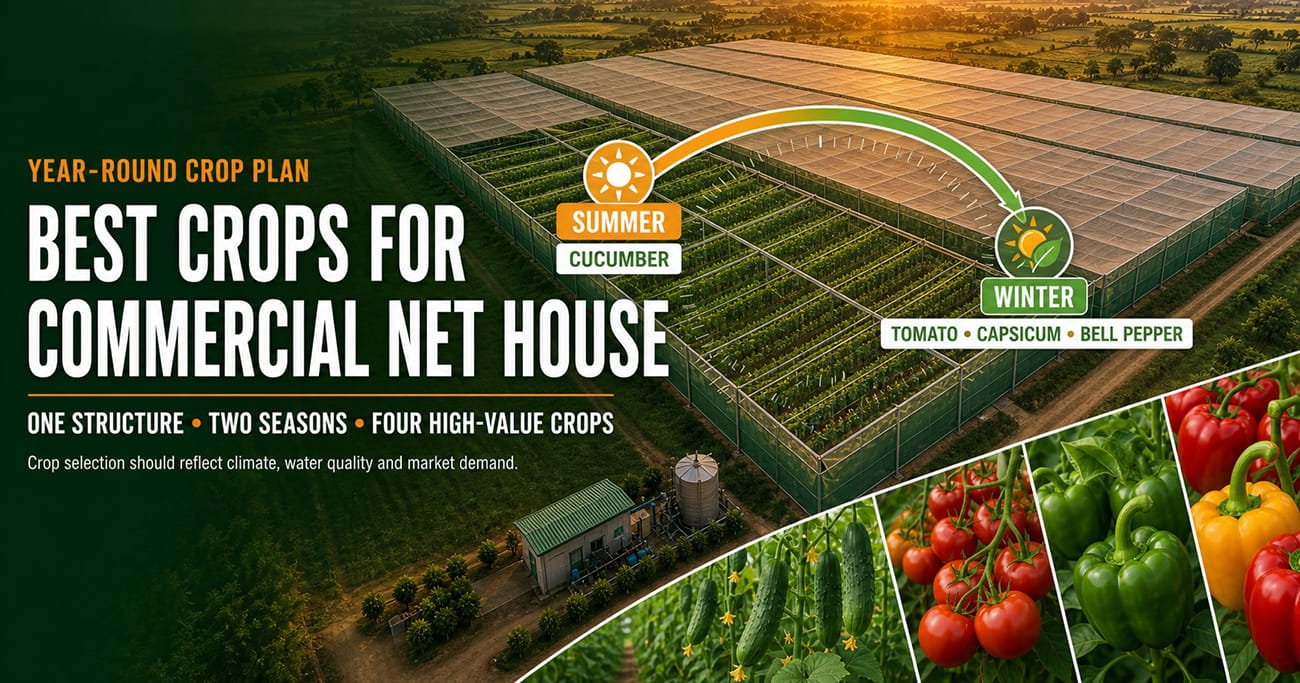
The net house runs a double crop: cucumber across all 10 acres in summer, then tomato and capsicum through winter. Indicative annual economics:
| Crop | Yield | Price | Revenue |
|---|---|---|---|
| Cucumber | 3,50,000 kg | ₹25/kg | ₹87.50 lakh |
| Tomato | 1,60,000 kg | ₹25/kg | ₹40.00 lakh |
| Capsicum | 1,50,000 kg | ₹30/kg | ₹45.00 lakh |
| Total revenue | ~₹1.72 crore | ||
| less annual OPEX | − ~₹64.70 lakh | ||
| Net profit / year | ~₹1.08 crore | ||
Because this is agricultural income, it is exempt under Section 10(1) of the Income Tax Act — the net profit is tax-free.
Working-capital requirement
One number investors often miss: you need working capital to fund a crop cycle before it pays back. Seedlings, inputs and labour are spent through the season; revenue only arrives at harvest. Plan for the operating cost of at least the first cycle — a meaningful share of the ~₹64.7 lakh annual OPEX — as working capital on top of the build cost, so the crop is never starved of inputs.
Indicative ROI and payback
Putting capital and returns together:
- Capital investment: ~₹2.49 crore
- Annual net profit: ~₹1.08 crore
- Return on investment: ~43% per year
- Payback period: ~2.3 years
ROI = annual net profit ÷ capital investment. Payback = capital investment ÷ annual net profit. After roughly two-and-a-half years of stable operation the project has, indicatively, returned its entire build cost — and continues to generate tax-free income every year thereafter. You can run these numbers for your own land size and crop on the net house investment calculator.
Self-funded versus bank-financed
There are two ways to fund the build:
- Self-funded: you invest the full ~₹2.49 crore. The entire net profit is yours, ROI and payback are as above, and there is no interest cost.
- Bank-financed: you fund part from equity and borrow the rest — for example under the Agriculture Infrastructure Fund (AIF), which offers an interest subvention. This frees your capital and spreads the cost, but interest reduces net cash flow and lengthens the effective payback.
Because Agrifirst runs net house as a non-subsidy model, you are not waiting on a subsidy sanction either way — you can start now. Which route is better depends on your cost of capital and how much you want to deploy up front.
How crop prices and yields change the picture
The single biggest swing factor is market price and yield. Hold the build and OPEX roughly constant and move revenue, and the returns move with it. Indicative sensitivity:
| Scenario | Annual revenue | Net profit | ROI | Payback |
|---|---|---|---|---|
| Downside (prices/yields ~20% lower) | ~₹1.38 crore | ~₹0.73 crore | ~29% | ~3.4 yrs |
| Expected (base case) | ~₹1.72 crore | ~₹1.08 crore | ~43% | ~2.3 yrs |
| Best case (~15% higher) | ~₹1.98 crore | ~₹1.34 crore | ~54% | ~1.9 yrs |
Even the downside case remains a healthy agribusiness return — but the range is real, and it is exactly why disciplined agronomy (to protect yield and quality) and dependable market linkage (to protect price) matter so much.
Why these projections need location-specific validation
No generic model can be your business plan. Before committing, validate:
- Water — the yield and quality of your source, tested.
- Agro-climate — whether your temperature and humidity band suits the crop plan.
- Market access — real, contracted buyers for your produce at premium prices.
- Management — who runs the crop, and their track record at commercial scale.
- Local costs — construction, labour and input prices in your region.
This is exactly what an Agrifirst project assessment does — it turns these indicative figures into a validated, site-specific plan.
Run your own numbers
A 10-acre commercial net house is, indicatively, a ~₹2.5 crore investment returning ~₹1 crore of tax-free profit a year at ~43% ROI and a ~2.3-year payback — provided the agronomy and market side are executed well. To pressure-test the model for your own land, use the investment calculator or request a project assessment from the Agrifirst team.