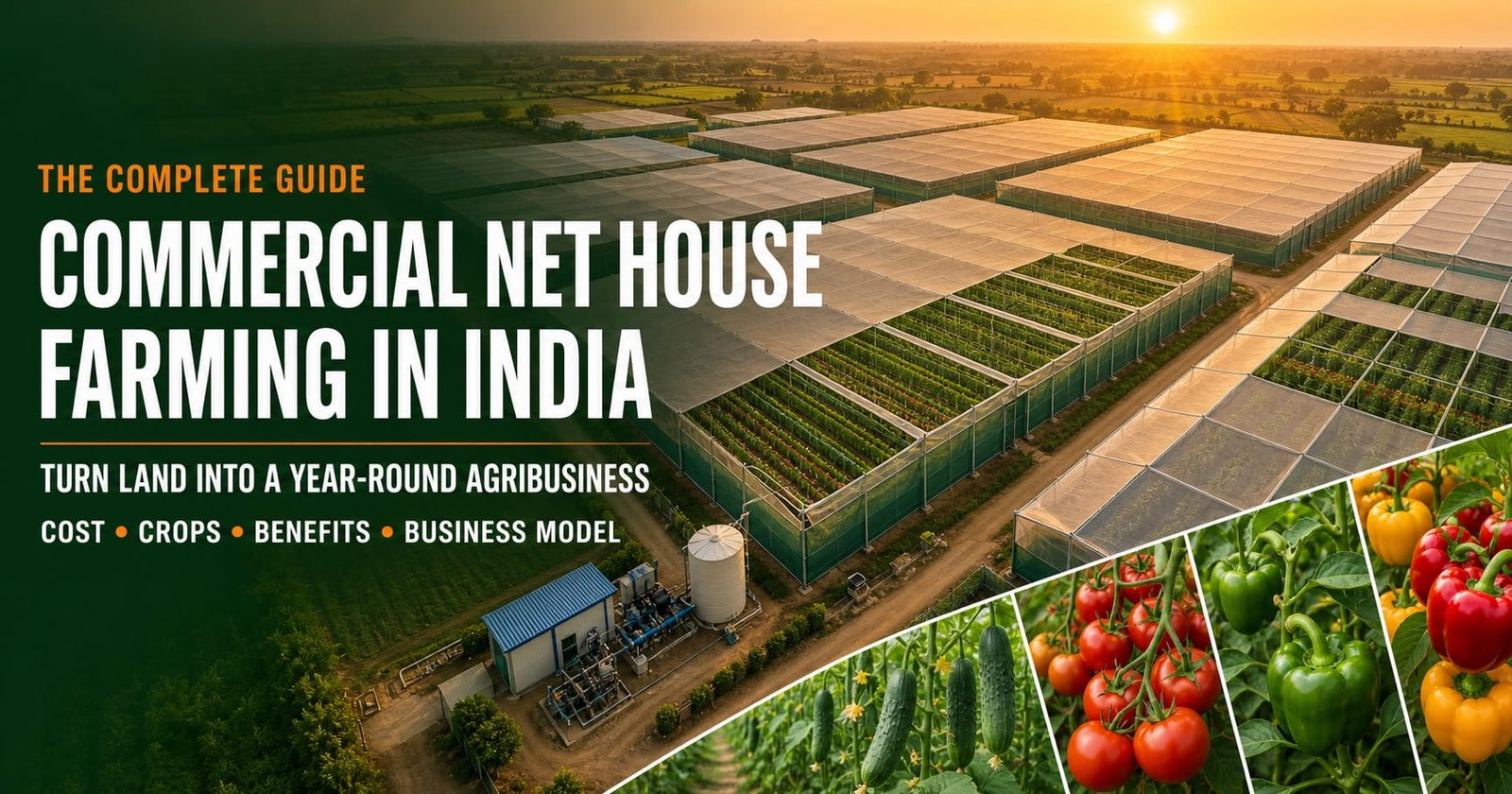
For decades, a “net house” in India meant a small shade structure over a few guntas of vegetables. That picture is out of date. At 10 acres and above, a net house becomes something very different — a structured, year-round agribusiness that supplies organised buyers at contracted prices, not a subsistence plot.
This guide explains commercial net house farming end to end: what the structure actually is, how it compares to open-field and polyhouse farming, the land and water you need, what a project is made of, the returns you can realistically expect, the risks to check before you invest, and how a partner like Agrifirst guides you through every step of it.
What is a commercial net house?
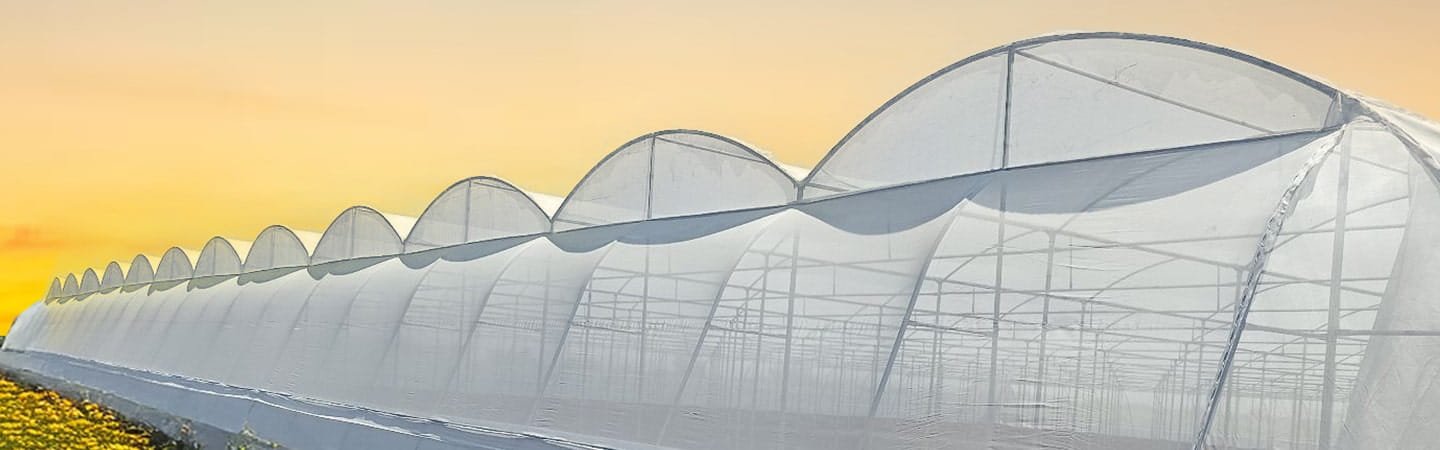
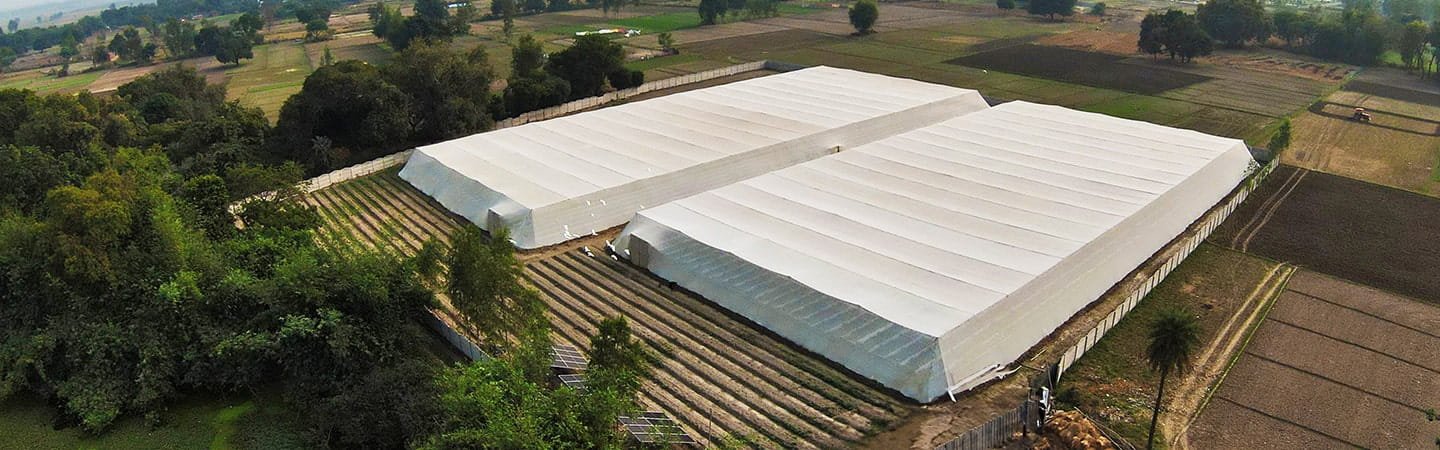
A net house (shade-net house) is a galvanised-iron (GI) framed structure covered with agricultural shade netting that creates a protected micro-climate for crops. The net cuts excess heat and sunlight, keeps insects and birds out, and shields the crop from wind, dust and hail — while still allowing natural ventilation.
“Commercial” simply means doing this at scale — 10 acres or more — with drip fertigation, planned crop rotations, trained labour and a route to organised markets. At that size the economics change completely: fixed costs get spread thin, buyers take you seriously, and the farm produces enough consistent volume to be run like a business.
Because it uses netting rather than a fully sealed, climate-controlled envelope, a net house delivers most of the benefits of protected cultivation at a fraction of a polyhouse’s cost — which is exactly why it has become the entry point for serious commercial farming in India.
Net house vs open-field farming
Open-field farming leaves the crop exposed to everything — pests, heat spikes, unseasonal rain, hail and price-crashing gluts. A net house changes the risk profile.
| Open field | Commercial net house | |
|---|---|---|
| Pest & insect pressure | High | Sharply reduced (physical barrier) |
| Heat / light stress | Full exposure | Moderated micro-climate |
| Yield per acre | Baseline | Typically much higher |
| Produce quality & grade | Variable | Consistent, retail/export grade |
| Water use | High | Lower (drip fertigation) |
| Weather & hail risk | High | Largely protected |
| Price realisation | Mandi-dependent | Premium, contracted buyers |
The result is higher yields, cleaner produce, fewer sprays, and — crucially — the ability to grow the high-value crops that organised buyers actually pay a premium for.
Net house vs polyhouse: which should you choose?
Both are protected-cultivation structures, and Agrifirst builds both. The difference is the level of control — and the cost.
| Net house (shade net) | Polyhouse (NVPH) | |
|---|---|---|
| Climate control | Partial (shade, ventilation) | High (naturally ventilated, covered) |
| Capital cost / acre | Lower | Higher |
| Payback | Faster | Longer |
| Best crops | Cucumber, tomato, capsicum, chillies | Coloured capsicum, exotics, cut flowers |
| Subsidy | Often run as a non-subsidy model | Typically NHB/NHM subsidy-linked |
| Complexity | Simpler to operate | More technical |
A simple way to decide: if you want a lower-cost, faster-payback entry into commercial protected farming with proven vegetable crops, the net house is usually the right first move. If you’re targeting the very highest-value crops (coloured capsicum, cut flowers) and can invest more, look at commercial polyhouse farming.
Why commercial scale (10+ acres) matters
Protected farming only becomes a real business at scale. Below a few acres you get a better vegetable plot; at 10 acres and above you get an enterprise. Three reasons:
- Buyers need volume. Supermarket chains, food companies and exporters buy on contract — they need reliable, graded volume week after week, which only a commercial-scale farm can supply.
- Fixed costs spread out. Agronomy, supervision, packhouse handling and logistics cost roughly the same whether you farm 2 acres or 10 — so per-acre overheads fall as you scale.
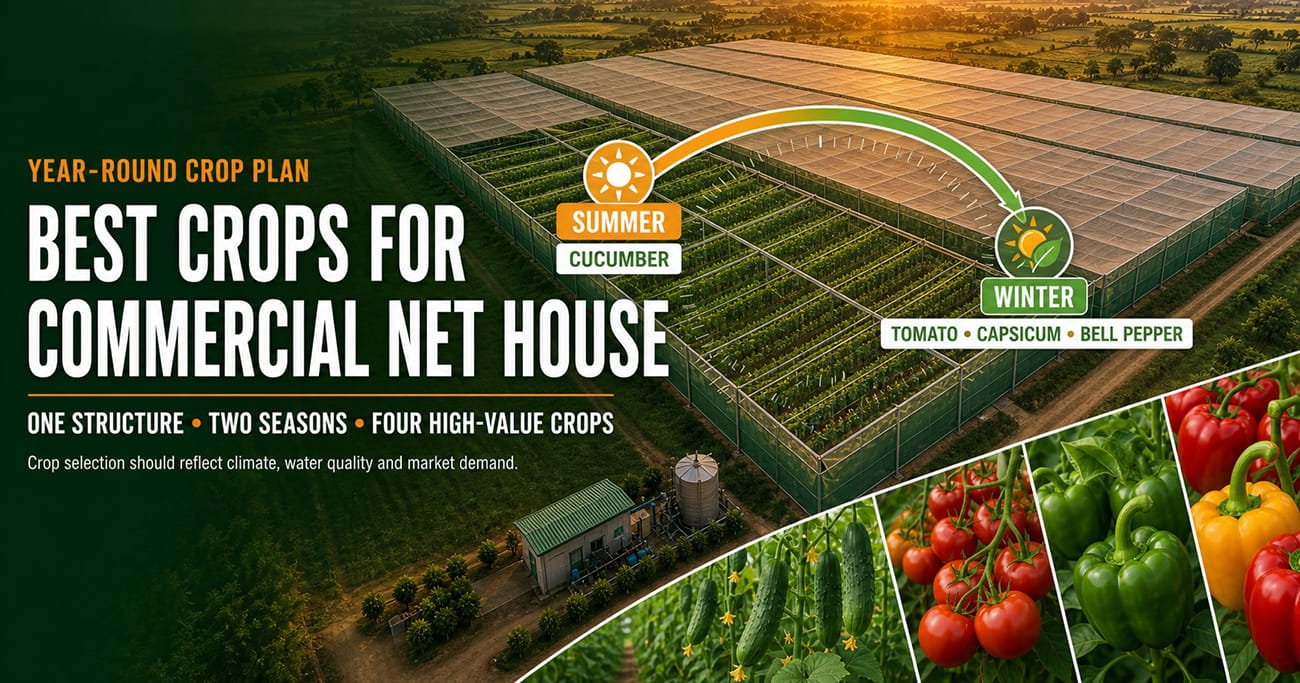
- A second crop fills the year. At commercial scale you can run a planned double-crop rotation — for example cucumber through summer, then tomato or capsicum through winter — so the structure earns income across all twelve months instead of one season.
Land, climate and water requirements
Before anything is built, the site has to qualify. A good commercial net house site needs:
- Contiguous land — ideally 10+ acres in one block, reasonably level, with road access for inbound material and outbound produce.
- A reliable water source — borewell, well or canal with enough year-round yield, and water quality (EC/pH) suitable for drip fertigation.
- A workable agro-climate — the local temperature and humidity band should suit the planned crops; the net house widens that band but doesn’t replace it.
- Power and labour — dependable power for pumps and fertigation, and access to trainable local labour.
A proper project always starts with a site and water assessment — skip it and you inherit avoidable problems later.
What a commercial net house project is made of
A turnkey 10-acre project is far more than “poles and net.” The major components are:
- GI structural framework — galvanised columns, cabling and foundations engineered for wind load.
- Shade netting — agricultural-grade net at the right shade percentage for the crop.
- Drip & fertigation system — precise water and nutrient delivery to every plant.
- Weed-mat, beds and trellising — for clean, disease-free, high-density cropping.
- Civil works — foundations, apron and pathways.
- Accessories — mulch, clips, twine, trays and crop-support hardware.
Build quality here directly determines the structure’s lifespan and how well it protects the crop — it is not the place to cut corners.
The benefits of protected cultivation
Put together, a commercial net house delivers:
- Higher yields per acre than open field.
- Better, more uniform quality that meets retail and export grades.
- Fewer pesticides thanks to physical pest exclusion.
- Water savings through drip fertigation.
- Weather protection from heat, wind, dust and hail.
- Year-round, plannable production that buyers can contract against.
The two things that make or break the business
A net house is only the hardware. Two things decide whether it becomes a profitable business:
- Agronomy. Crop planning, nursery, nutrition, irrigation scheduling and integrated pest management (IPM) have to be done right, cycle after cycle. Good agronomy is the difference between an average yield and a premium one.
- Market linkage. Growing quality produce means little if you sell it into a crashing mandi. The value is captured only when the harvest goes to organised buyers — supermarkets, food processors and exporters — at contracted, premium prices.
An investor who owns the land but doesn’t have deep agronomy and buyer relationships needs a partner who does. That is the core of a hand-held commercial model.
The economics: what returns to expect
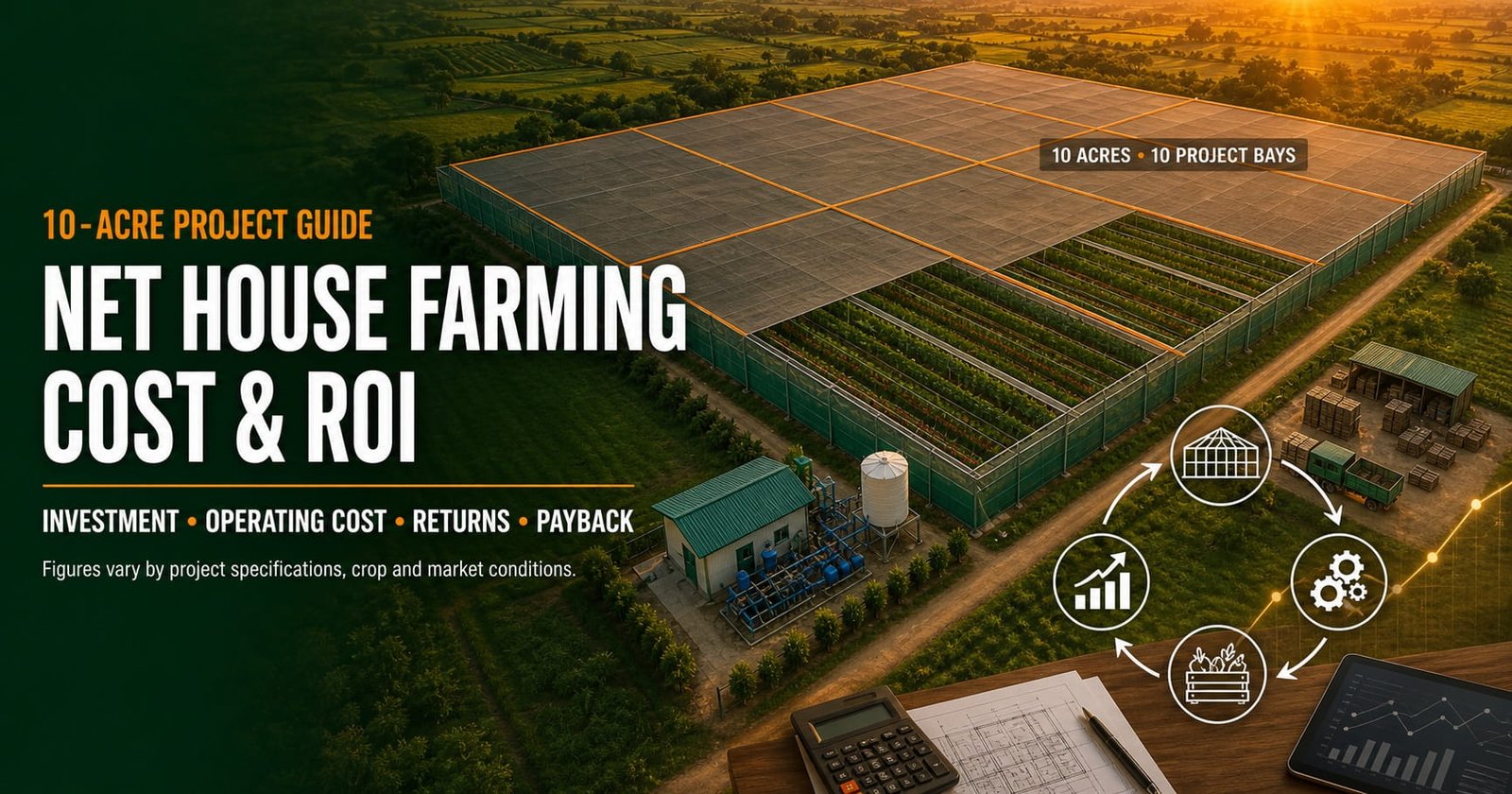
Numbers vary with crop, market and management, so treat these as indicative, not guaranteed. For a well-run 10-acre commercial net house on Agrifirst’s double-crop model:
- Project cost: roughly ₹2.5 crore (about ₹25 lakh per acre).
- Annual revenue: in the region of ₹1.7 crore.
- Annual net profit: around ₹1 crore.
- ROI: roughly 40%+ per year, with payback in about 2–2.5 years.
- Tax: income from agriculture is exempt under Section 10(1) of the Income Tax Act.
You can model your own numbers — land size, crop and price — with the net house investment calculator on our commercial net house page.
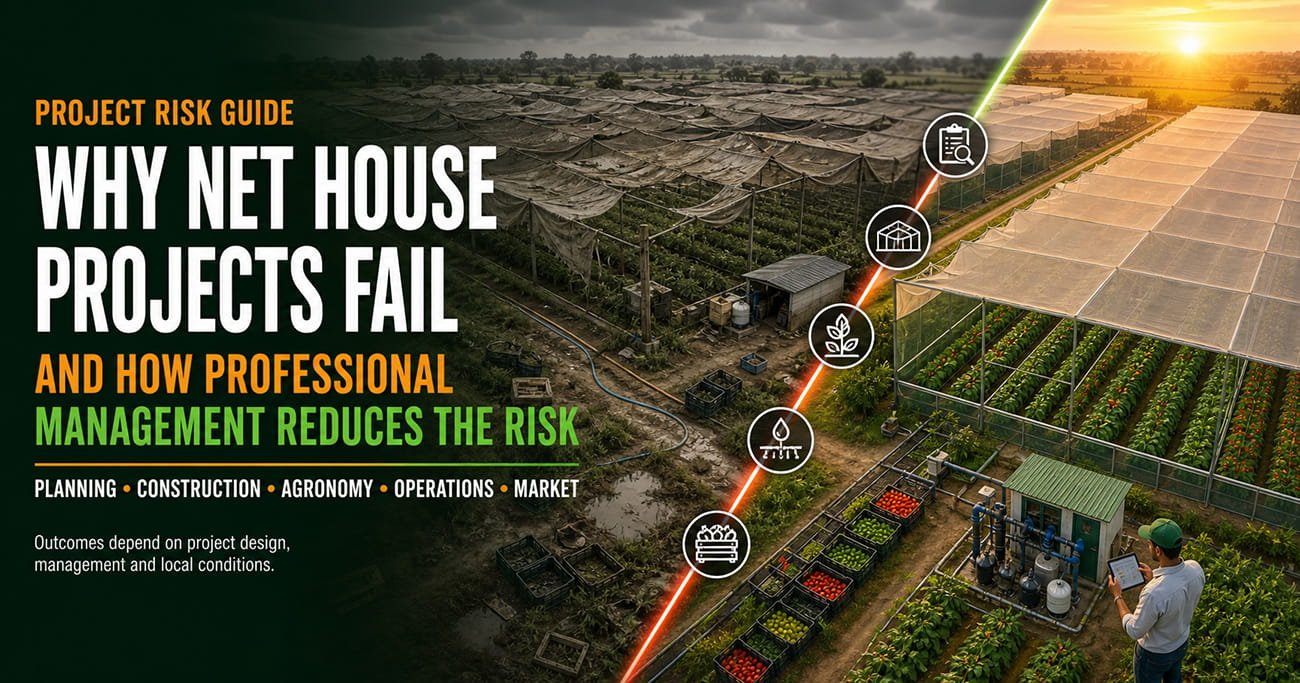
Risks and due diligence before you invest
Every real business has risk. The ones that matter here — and how to check them:
- Execution / agronomy risk. Ask who actually runs the crop, and whether they’ve done it at commercial scale before.
- Market risk. Confirm there is a real buyer network and, ideally, contracted off-take — not just a promise to “help you sell.”
- Water risk. Insist on a water yield and quality test before committing.
- Build-quality risk. Check the structural spec, materials and warranty — a cheap structure fails early.
- Partner credibility. Look for a track record, references and a genuinely end-to-end scope rather than a one-time construction contract.
Doing this diligence up front is what separates a sound investment from an expensive lesson.
How Agrifirst guides your net house project
Agrifirst delivers commercial net house farming as a fully guided, non-subsidy model — you own and run the project, and our agronomists and team guide you at every step on exactly what to do, when and how:
- Non-subsidy — no waiting for sanctions. You start now instead of waiting months for a subsidy file to clear.
- Full agronomy support & hand-holding — design, crop planning, certified seedlings, scheduled agronomist visits, nutrition and pest management, cycle after cycle. Our experts guide the decisions; your team carries them out.
- Complete market linkage — we connect you to organised buyers (supermarkets, food companies and exporters) and guide the sale at premium, contracted prices.
In short: you run the project, we guide every step, and the tax-free profit is yours. See the full model, economics and crop plan on our commercial net house farming page.
Ready to explore your own project?
Commercial net house farming is one of the most accessible ways to turn idle land into a genuine, tax-free agribusiness — if the agronomy and market side are handled properly. If you’re a landowner or investor evaluating the opportunity, talk to the Agrifirst team for a site assessment and a project plan built around your land.