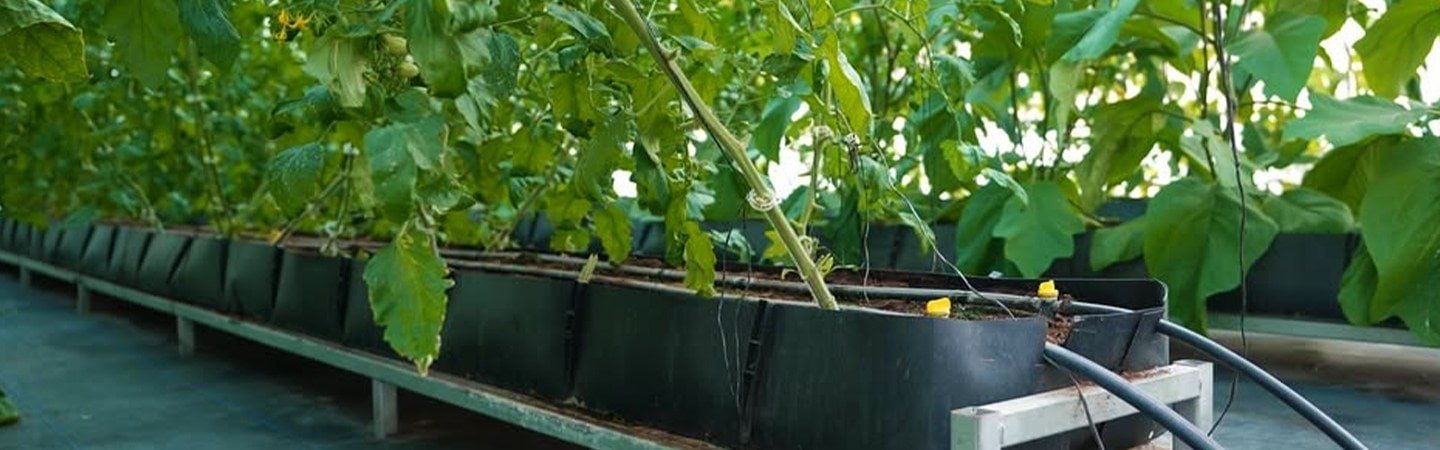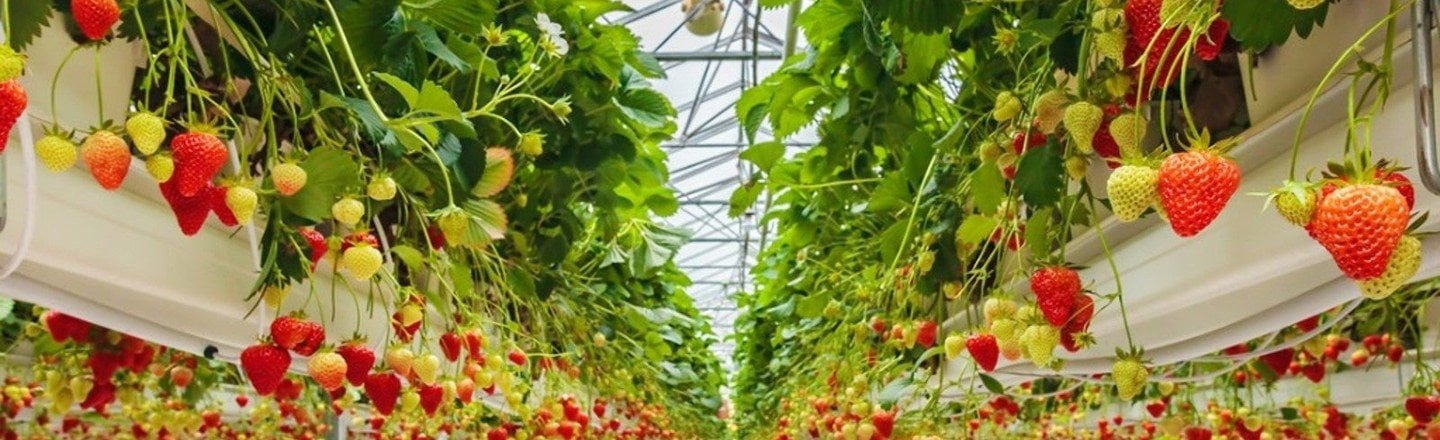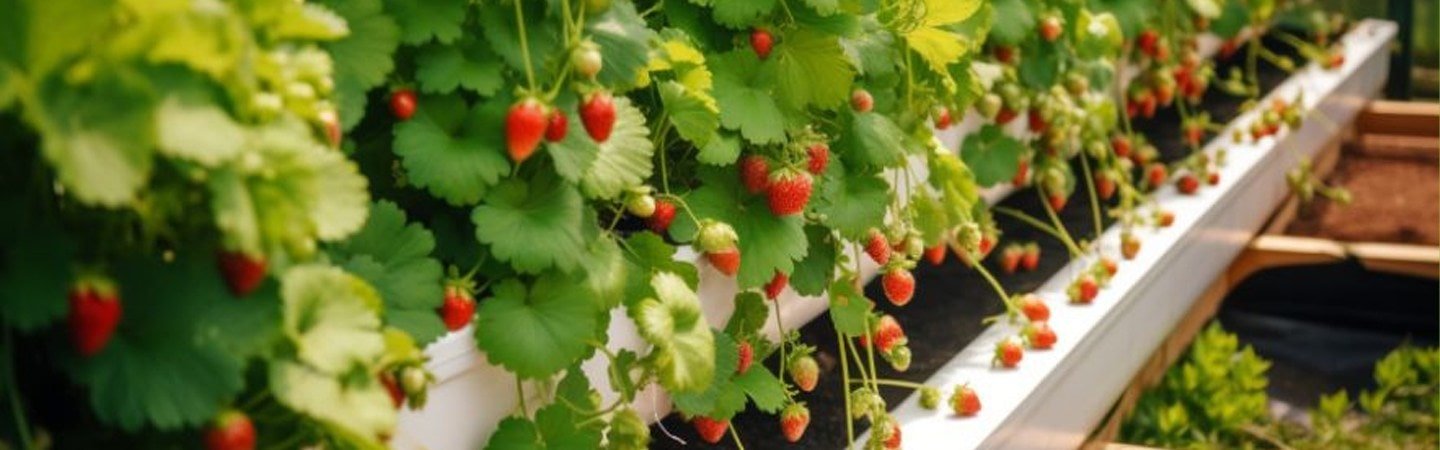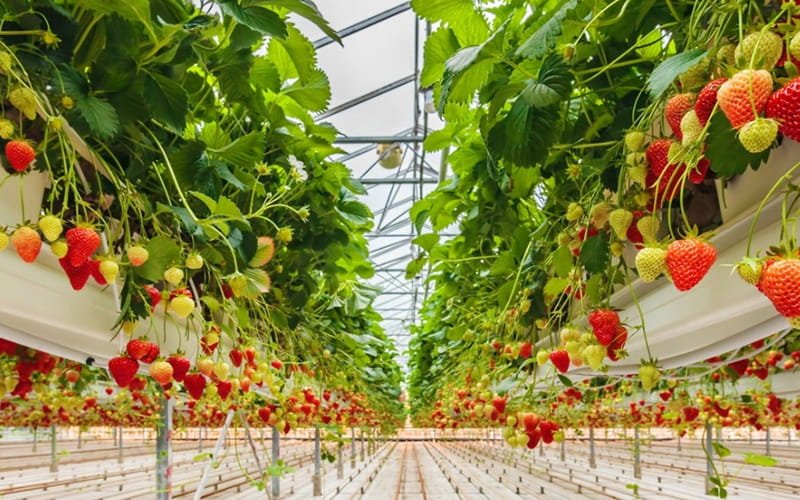

Strawberry Cultivation In Polyhouse changes the way the crop is organised, irrigated, fed and managed compared with conventional open-field cultivation. At Mahaberry Farm, the system demonstrated to AgriFirst combined hanging gutters, closer plant spacing, 100% Cocopeat, automated irrigation and fertigation, temperature management and a protected growing environment.
AgriFirst Senior Agronomist Peeyush explored this production model with Sunil Nanaso Bhilare at Mahaberry Farm in Satara district, near Pune and close to Mahabaleshwar. At the time of the visit, the strawberry plants inside the greenhouse were in their vegetative phase and were being grown in a hanging gutter system.
The discussion is particularly relevant for greenhouse growers considering strawberry as a commercial crop. Instead of evaluating only the strawberry variety, the farm visit shows how plant population, fruit position, root-zone space, water, fertigation and temperature become connected parts of the production system.
Quick Answer: At Mahaberry Farm, Sunil Ji compared approximately 20,000–22,000 strawberry plants per acre in open cultivation with up to 40,000–50,000 plants in the hanging gutter polyhouse system. The demonstrated system used 100% Cocopeat, automated irrigation and fertigation, and temperature management through sensors and foggers.
Strawberry Cultivation: Open Field vs Polyhouse
One of the clearest differences discussed at Mahaberry Farm was plant spacing. According to Sunil Ji, strawberry plants in open cultivation are planted at around 1-foot spacing, while the plants in the hanging gutter system being demonstrated were positioned at approximately half a foot.
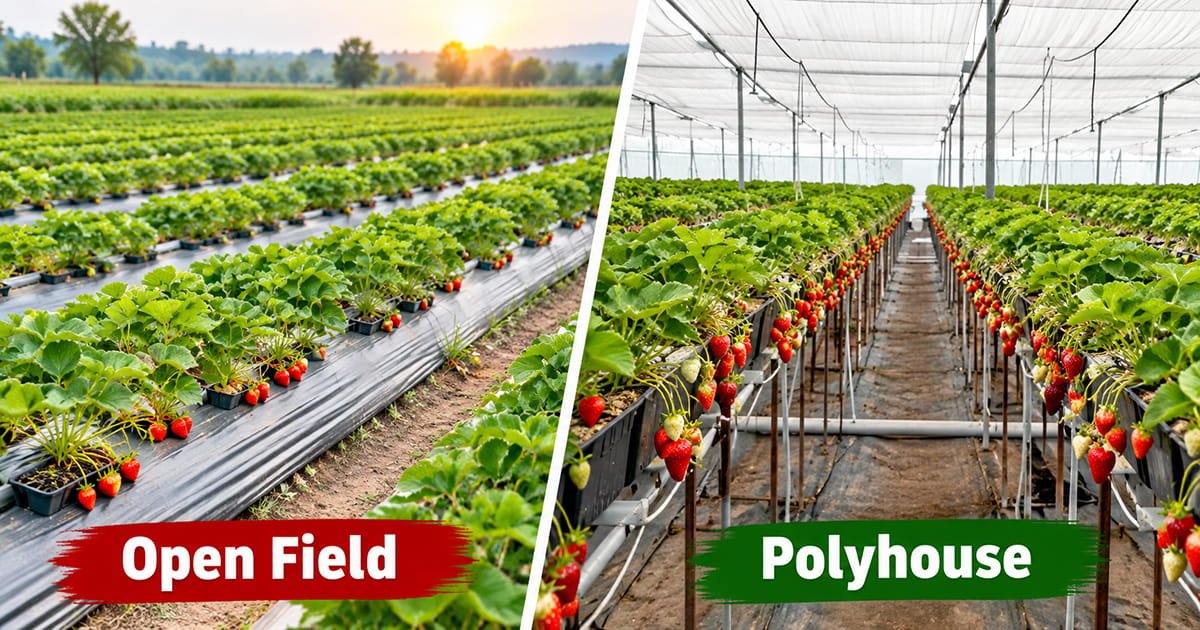
Sunil Ji connected this difference with the position of the fruit and its exposure to sunlight. In open cultivation, the fruit requires enough space to receive light. When plants are brought closer together, the stalk and fruit can move into the plant's shadow, creating a problem for proper ripening.
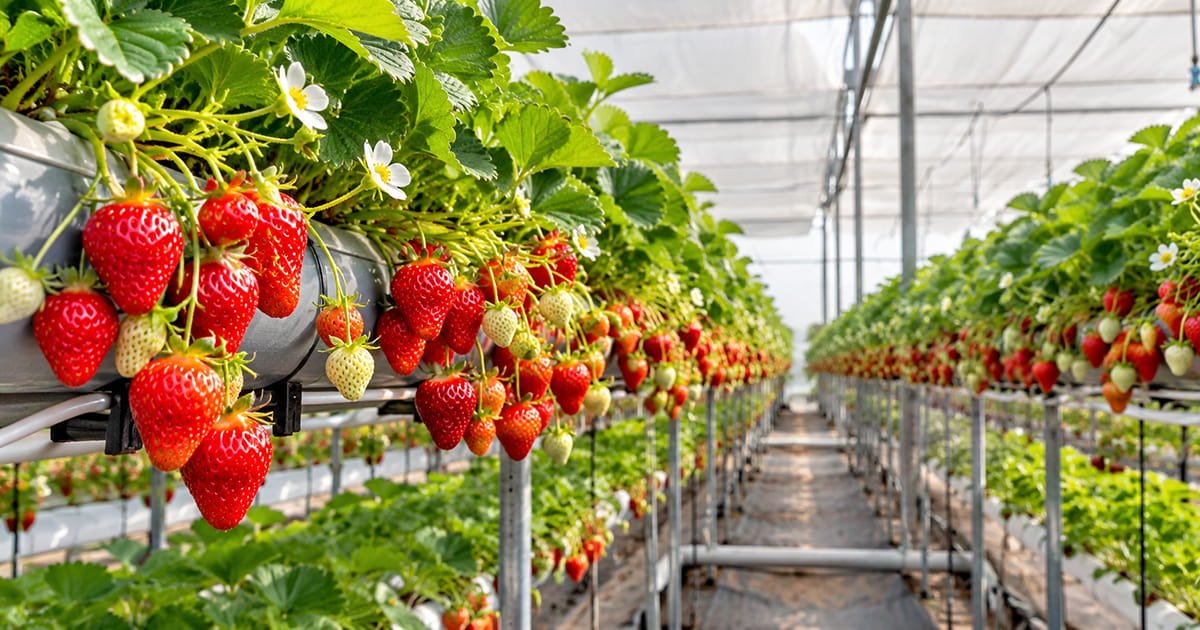
The hanging arrangement changes the position of the strawberry fruit. Instead of remaining crowded around the growing surface, the fruit comes down from the plant. Sunil Ji explained that this position helps the strawberry develop a good conical shape while allowing the fruit to receive air and sunlight.
This is why spacing cannot be considered separately from the growing system. In the model demonstrated at Mahaberry Farm, the strawberry hanging gutter system changes how the plants and fruit occupy the available space.
How Does a Strawberry Hanging Gutter System Increase Plant Population?
Plant population was one of the most important commercial differences discussed during the farm visit. Sunil Ji explained that open cultivation accommodates approximately 20,000–22,000 strawberry plants per acre. In the hanging gutter system inside the polyhouse, he described a population of up to 40,000–50,000 plants per acre.
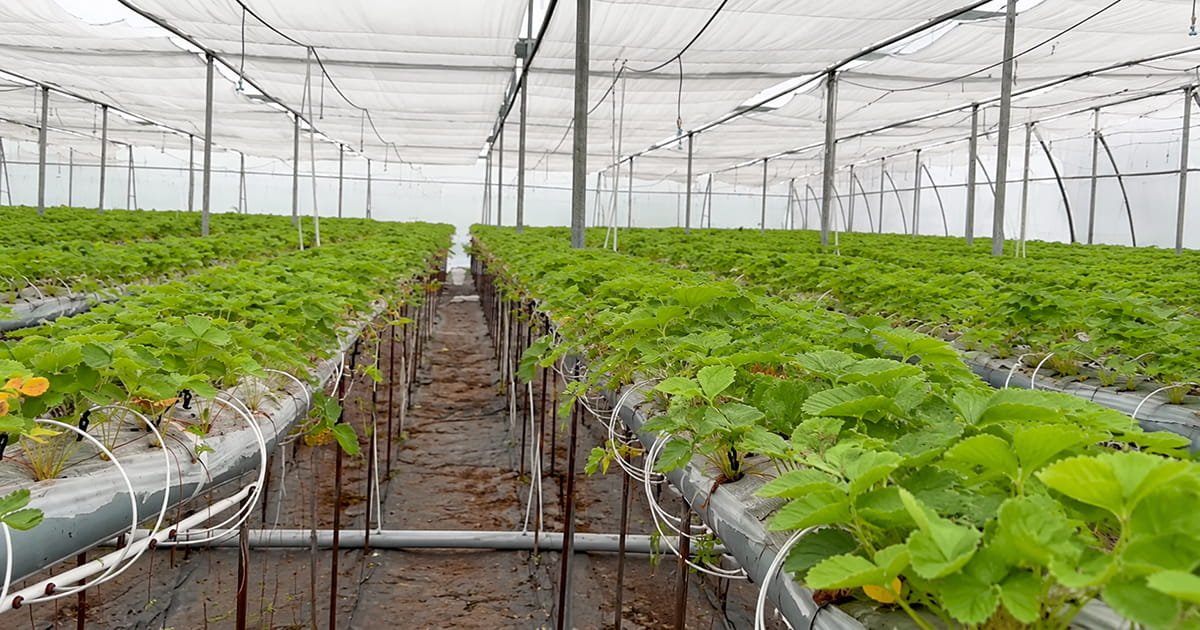
In practical terms, Sunil Ji described this as the ability to plant around double the number of plants. The importance of that difference becomes clearer when plant population is later combined with the per-plant production examples discussed at the farm.
| Production Factor | Open Cultivation | Polyhouse Hanging Gutter |
|---|---|---|
| Plant spacing discussed | Around 1 foot | Around half a foot in the demonstrated system |
| Plants per acre discussed | 20,000–22,000 | Up to 40,000–50,000 |
| Growing environment | Open | Protected, with temperature management discussed |
| Root-zone medium described | Soil | 100% Cocopeat |
For growers evaluating this type of protected cultivation, the hanging arrangement therefore affects more than fruit position. It changes how many plants can be accommodated within the acre and, consequently, the production potential discussed at the farm.
Growers exploring this broader protected-cultivation approach can also review AgriFirst's greenhouse and polyhouse solutions.
Strawberry Soilless Cultivation with 100% Cocopeat
The Mahaberry Farm system was not based on field soil. When Peeyush specifically asked about the growing medium being used, Sunil Ji confirmed that the strawberries in the demonstrated system were being grown completely in 100% Cocopeat.
That raised an important practical question during the visit: if a strawberry plant is growing inside a relatively narrow gutter or pipe, does its root system have enough space?
Sunil Ji explained that the roots do not depend only on vertical depth. They spread through the available width of the growing system. He described the root development by explaining that if the plant were lifted, the developed root mass would come out together from the pipe.
Root-zone observation from Mahaberry Farm: the demonstrated strawberry system used 100% Cocopeat. Sunil Ji explained that the roots spread through the available width, with the developed root mass occupying the growing space inside the pipe.
The strawberry soilless cultivation approach shown at Mahaberry Farm therefore connects the hanging gutter with its Cocopeat root zone. The plant is not simply suspended above the ground; its roots occupy a defined growing space that is managed through the irrigation and fertigation system.
How Are Irrigation and Fertigation Managed?
With the strawberry roots growing in Cocopeat rather than field soil, water and fertigation become important parts of the system. During the discussion, Peeyush compared this approach with other soilless growing systems where irrigation may be provided several times during the day.
Sunil Ji explained that the Mahaberry system operates through automation. He described water being supplied for a maximum of around five minutes. Within his explanation of this cycle, the first water is released and the second water fills into the growing system.
Fertigation is supplied with the watering process. According to Sunil Ji, there is no need to release a large quantity of water into the system; water can instead be supplied together with fertigation through the controlled cycle.
What Did Sunil Ji Say About Fertiliser Requirement?
Sunil Ji also made a direct comparison between the fertiliser requirement he associated with soil cultivation and the polyhouse system being discussed. In his farm-level comparison, he stated that where 1 kg might be required for a plant in soil, approximately 100 grams was more than enough in the polyhouse system he was describing.
He presented this comparison as one of the reasons the running expense can be lower in this protected soilless model. These figures reflect Sunil Ji's explanation of the system at Mahaberry Farm rather than a general fertiliser schedule for every strawberry project.
Temperature Management Inside the Polyhouse
Temperature was another major point in the comparison between open-field and protected strawberry cultivation. Sunil Ji explained that when outside temperatures increase, the grower cannot control those outdoor conditions in the same way. Inside the protected system being discussed, temperature can be managed.
He described a setup where a sensor detects an increase in temperature and starts the fogger. The fogger then brings the temperature down automatically. To explain the level of control, Sunil Ji used two example ranges: if the requirement is 25–30, that range can be maintained, and if the requirement is 20–25, the system can be managed accordingly.
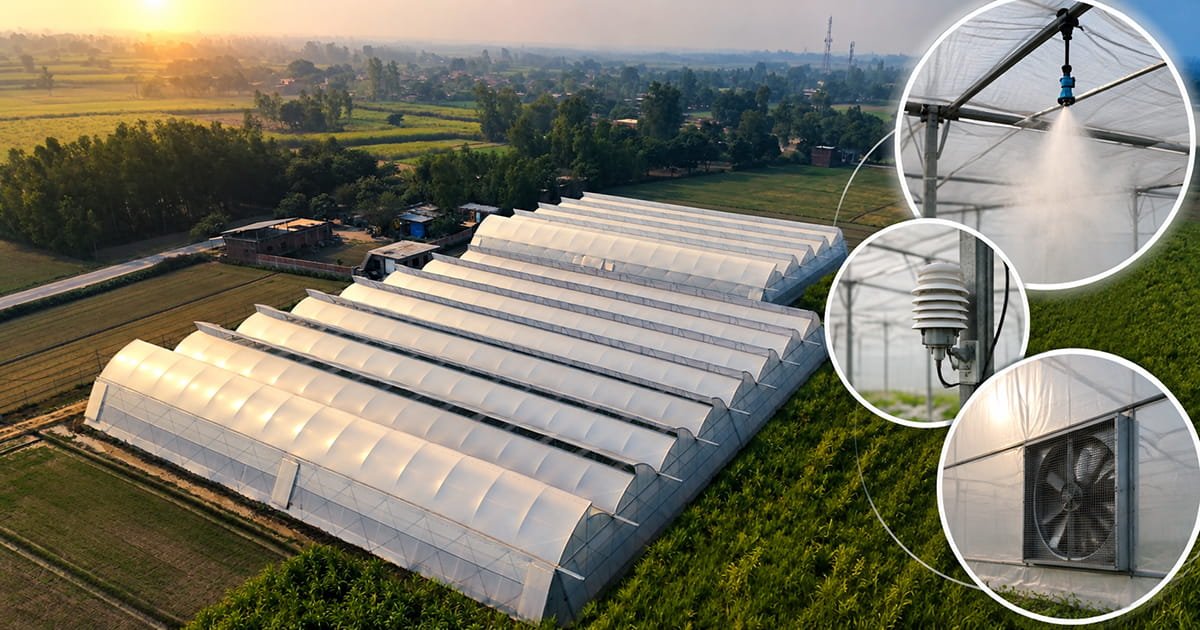
Sunil Ji further explained that colder conditions are generally better for strawberry and connected the ability to manage temperature with the potential for higher yield. Within the farm discussion, the central advantage was the ability to respond when the temperature changes instead of depending entirely on the outdoor environment.
How Does Diffuse Light Affect the Fruit?
Peeyush also pointed to the diffuse light inside the greenhouse. He explained that diffuse light reaches the crop from different directions and observed that the resulting fruit colour is quite good.
This works alongside the fruit position described by Sunil Ji. In the hanging gutter arrangement, the strawberry fruit comes down from the plant, where it can receive air and light instead of remaining shaded within closely spaced plants.
How Long Can Strawberry Production Continue in Mahabaleshwar?
The Mahaberry Farm discussion also provides a direct reference for strawberry farming in Mahabaleshwar. According to Sunil Ji, strawberry can produce for approximately 8–9 months.
He explained that plantation in Mahabaleshwar is carried out in September. Strawberries are then plucked until June, with fruiting continuing through June.
Production timeline discussed by Sunil Ji:
Plantation: September | Production period: 8–9 months | Fruiting and harvesting: up to June
Water availability is important within this timeline. Sunil Ji explained that if sufficient water is available, production can continue easily until June. He also stated that the polyhouse model requires considerably less water.
In his explanation, using less water means the available water can last for more days. At the same time, the ability to maintain cooler conditions inside the protected environment was discussed as another factor supporting the longer production period.
Polyhouse Strawberry Yield Per Acre: What Numbers Were Discussed?
The production discussion at Mahaberry Farm connected two variables: the number of plants accommodated within an acre and the amount of strawberry produced by each plant.
Sunil Ji used 0.5 kg per plant as a conservative production example. He also explained that production can reach 1 kg per plant when the crop performs very well.
Using the conservative example, his calculation was straightforward. At 20,000 plants and 0.5 kg per plant, total production becomes 10 tonnes. At 40,000 plants with the same 0.5 kg per-plant example, production becomes 20 tonnes.
| Example Discussed | Plant Count | Yield Per Plant | Total Production |
|---|---|---|---|
| Lower-density example | 20,000 | 0.5 kg | 10 tonnes |
| Hanging gutter example | 40,000 | 0.5 kg | 20 tonnes |
Separately from these illustrative calculations, Peeyush later discussed the commercial economics using a production reference of approximately 25 tonnes. He also stated during the discussion that around 1 kg per plant can be achieved in the system.
Keeping these examples separate is important. The 10-tonne and 20-tonne figures come directly from the 0.5 kg-per-plant calculation, while the approximately 25-tonne figure was a separate production reference used by Peeyush when discussing commercial potential.
What Did Sunil Ji Say About Disease, Water and Running Costs?
Sunil Ji described disease protection as another advantage he associated with the protected system. During the farm discussion, he stated that because the crop is inside the polyhouse, diseases do not come into the system and the crop is saved from diseases. This is presented here as Sunil Ji's observation and claim about the system being discussed at Mahaberry Farm.
He also acknowledged the other side of the investment equation. According to Sunil Ji, the one-time expense of establishing the polyhouse and hanging system is high. His argument was that the infrastructure has a long life and that the higher yield achieved in comparison with outside cultivation changes the longer-term economics.
In the same farm-level comparison, Sunil Ji stated that the maximum yield captured through this approach could be five times higher than outside cultivation. This figure reflects the claim he made while explaining the Mahaberry Farm system.
Water was another recurring part of his comparison. Sunil Ji described the protected system as requiring less water. He connected that reduction with the production window: if less water is required, the water available to the grower can last for more days.
Production and Market Economics Discussed at Mahaberry Farm
Peeyush connected the technical discussion at Mahaberry Farm with the strawberry market conditions he described in North India. According to Peeyush, strawberry rates in North India remain around ₹120–₹180 per kg.
He then considered the commercial opportunity from the perspective of obtaining approximately 25 tonnes of production. Peeyush described the resulting opportunity positively when considering strawberry as a short-term crop.
Commercial context from the farm discussion: Peeyush referenced approximately 25 tonnes of production alongside a North India strawberry price range of ₹120–₹180 per kg. The discussion did not provide a complete polyhouse project cost, operating-cost calculation or guaranteed profit figure.
That distinction matters when looking at the economics. The discussion provides production examples, plant-density figures and a regional market-rate reference, but it does not provide a complete profit-and-loss calculation for a strawberry project.
The commercial logic presented at Mahaberry Farm instead starts with the production system itself: accommodate more plants, manage their roots in Cocopeat, control irrigation and fertigation, manage temperature and create the conditions described for a longer production window.
What Can Commercial Growers Learn from the Mahaberry Farm Model?
The Mahaberry Farm visit shows that moving strawberry from open cultivation into a hanging-gutter polyhouse is not simply a matter of putting the same crop under a protected structure. The production arrangement itself changes.
Plant spacing becomes closer. The fruit hangs downward, where Sunil Ji explained that it receives air and sunlight and can develop a good conical shape. The roots grow in 100% Cocopeat and spread through the available width of the growing channel. Water and fertigation are delivered through automation, while sensors and foggers are used in the temperature-management approach described at the farm.
The commercial significance comes from how these elements work together. Higher plant population changes the production equation per acre. The contained Cocopeat root zone changes the way irrigation and fertigation are managed. Temperature management changes how the grower can respond to heat. The Mahabaleshwar production calendar discussed by Sunil Ji extends from September plantation through harvesting up to June.
For greenhouse growers considering strawberry as another commercial crop, the Mahaberry discussion therefore points beyond variety selection alone. Plant accommodation, root-zone space, fruit position, irrigation, fertigation, water availability, temperature and the productive period all form part of the same decision.
Is a Hanging-Gutter Polyhouse Model Worth Exploring for Strawberry?
For growers evaluating strawberry cultivation in polyhouse, the Mahaberry Farm discussion provides a practical way to examine the model: look at the complete production system rather than considering plant density or yield as isolated figures.
The comparison presented at the farm begins with approximately 20,000–22,000 plants per acre in open cultivation and reaches up to 40,000–50,000 plants in the hanging gutter polyhouse system. From there, the discussion connects plant population with Cocopeat-based growing, automated irrigation and fertigation, temperature management, fruit exposure and the 8–9-month production period described for Mahabaleshwar.
The production figures and commercial claims also need to be understood in the context in which Peeyush and Sunil Ji presented them at Mahaberry Farm. Sunil Ji used 0.5 kg per plant as a conservative production example and discussed up to 1 kg per plant when performance is very good, while Peeyush separately referenced approximately 25 tonnes when discussing the commercial opportunity and North India strawberry rates of ₹120–₹180 per kg.
Taken together, the farm discussion shows why a commercial strawberry project needs to be evaluated as an integrated growing system: structure, hanging gutters, plant population, Cocopeat, irrigation, fertigation and environmental management all influence how the crop is organised and operated.
Planning Strawberry Cultivation in a Polyhouse?
A commercial strawberry project brings the growing structure, hanging system, plant density, Cocopeat root zone, irrigation, fertigation and climate-management approach together as one production system. If you are exploring this type of protected-cultivation project, discuss your requirements with the AgriFirst team.