
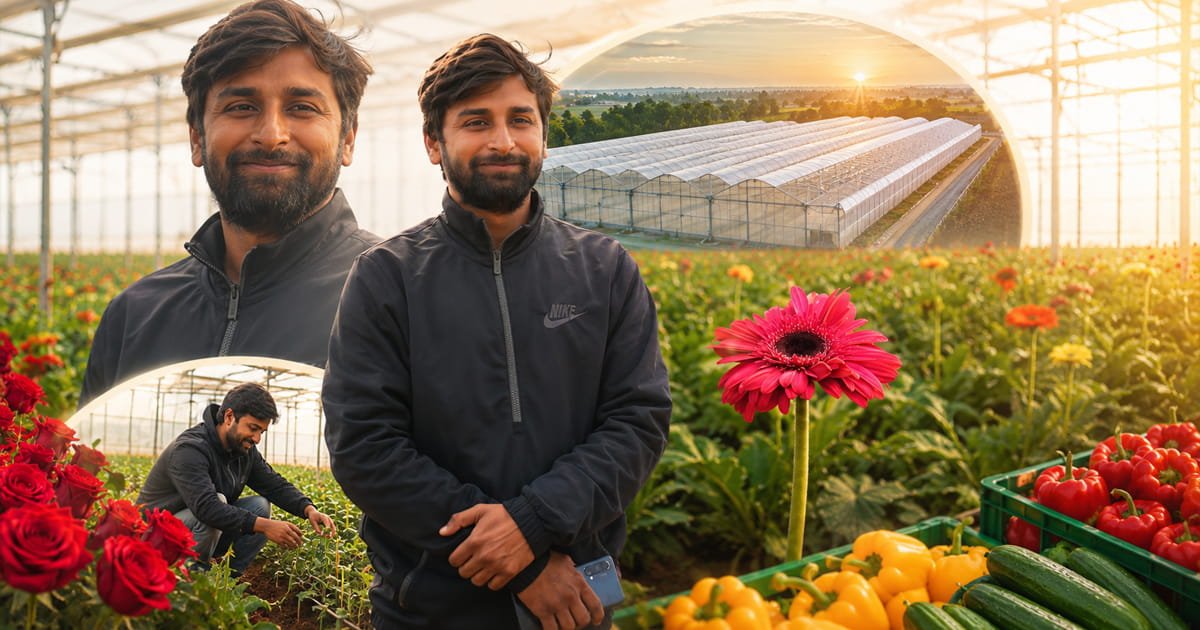
"I used to worry about whether I could feed my family from this land. Today, that same land earns me ₹29 lakh a year — and I have Agrifirst to thank for showing me the way."
From Uncertainty to ₹29 Lakh: A Farmer's Transformation
The district of Mirzapur, tucked along the banks of the Ganga in Uttar Pradesh, is not traditionally known for high-value horticulture. For most of its farmers, life is a cycle of traditional crops, unpredictable monsoons, and thin margins. Balesh Pratap Singh was one of those farmers — until he chose a different path.
In 2021, Balesh — a graduate in agricultural science with 8 years of conventional farming experience — took a calculated risk. He reached out to Agrifirst, a leading name in protected cultivation and polyhouse infrastructure across India. What followed was not just a farming upgrade. It was a complete life transformation.
Today, from just 1 acre of polyhouse land, Balesh generates an annual income exceeding ₹29 lakh, producing premium-grade capsicum and cucumber that command top prices in city markets. His story is one of the most compelling polyhouse farming success stories to emerge from rural Uttar Pradesh.
📊 Balesh Pratap Singh — Farm at a Glance
| 📍 Location | Mirzapur, Uttar Pradesh |
| 🌿 Farm Area | 1 Acre (Polyhouse) |
| 🫑 Primary Crops | Capsicum, Cucumber |
| 💰 Annual Income | ₹29+ Lakh |
| 🏗️ Infrastructure Partner | Agrifirst |
| 🏛️ Subsidy Availed | UP Horticulture Mission (NHM) |
| 📅 Started | 2021 |
The Challenge: Traditional Farming Was Not Enough
Before his polyhouse venture, Balesh cultivated wheat and paddy on his inherited 2.5-acre land. Like millions of Indian farmers, he was caught in a familiar trap: rising input costs, volatile crop prices, dependency on monsoon rains, and post-harvest losses due to poor storage and market access.
"My net profit some years was barely ₹80,000 from the entire farm," Balesh recalls. "After deducting seeds, fertilizers, labour, and irrigation, there was almost nothing left. I was working harder than any office employee but earning less."
The turning point came when Balesh attended a hi-tech agriculture workshop organized by the Uttar Pradesh Horticulture Department. There, he learned about polyhouse farming — controlled-environment agriculture that allows year-round crop production, free from weather volatility and pest pressure.
Why Polyhouse? And Why Agrifirst?
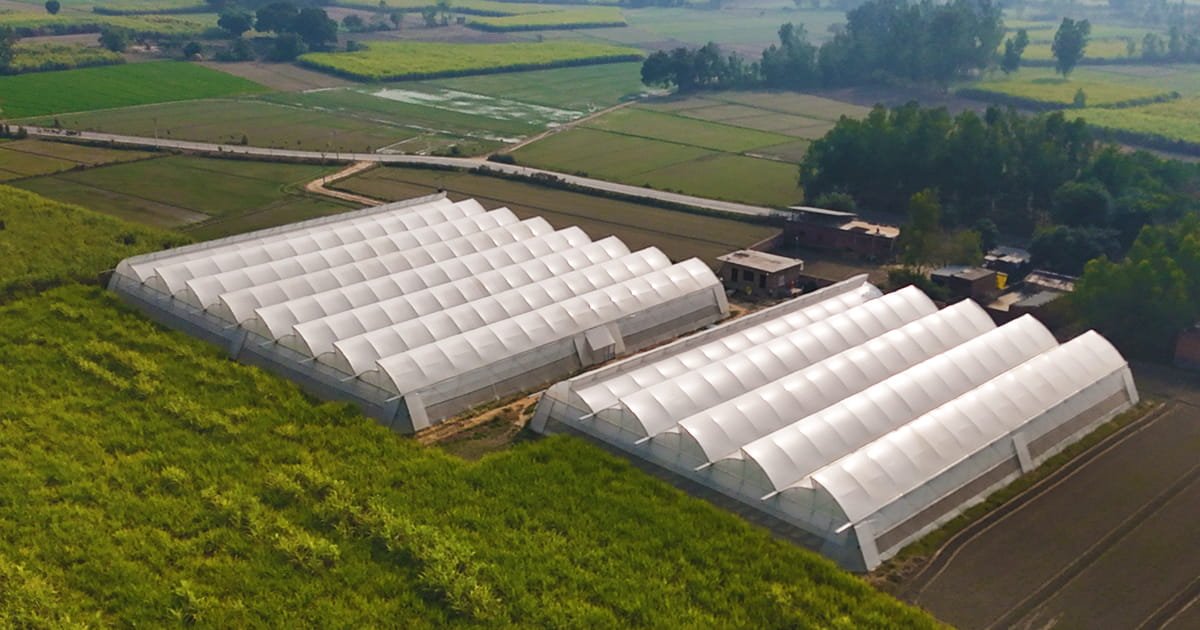
Polyhouse farming — also called greenhouse farming or protected cultivation — involves growing crops inside a structure covered with UV-stabilized polythene film. The enclosed environment shields crops from rain, extreme heat, cold, insects, and disease, drastically reducing crop failure risk and improving quality consistency.
After researching multiple vendors, Balesh chose Agrifirst for one simple reason: end-to-end support. Unlike other suppliers who only sold the structure, Agrifirst provided:
- Site survey and soil testing before design
- Custom polyhouse design suited to Mirzapur's microclimate
- Assistance with government subsidy application under the National Horticulture Mission (NHM)
- Installation with galvanized steel framework and anti-insect nets
- Drip irrigation and fertigation system setup
- Crop selection guidance — identifying capsicum and cucumber as the highest-value crops for his region
- Post-installation training and ongoing technical support
"The Agrifirst team visited my farm before I even signed any contract," Balesh says. "They measured the land, tested the soil, and only then told me what structure would work best. That confidence was what made me trust them."
Building the Polyhouse: Investment, Subsidy & Setup
The total cost of establishing a 1-acre naturally ventilated polyhouse in Mirzapur — including structure, cladding, drip irrigation, and fertigation — came to approximately ₹28 lakh. Under the UP Horticulture Mission linked to the National Horticulture Mission (NHM), Balesh received a 50% capital subsidy, reducing his personal investment to around ₹14 lakh.
The NHM is one of the sub-schemes operating under the Mission for Integrated Development of Horticulture (MIDH) — the Government of India's umbrella framework that funds polyhouse, drip-irrigation, and protected cultivation projects across the country. Cost norms, scheme guidelines, and the official application format are revised periodically and published on the MIDH and NHM portals.
Agrifirst's team guided Balesh through the entire subsidy process — from filling the DPR (Detailed Project Report) to liaising with the district horticulture officer and ensuring the structure met all government specifications required for subsidy release.
"The paperwork can be very confusing. But Agrifirst had done this many times before. They made the entire subsidy process smooth for me," Balesh explains.
Construction took approximately 45 days. The polyhouse was equipped with:
- 200-micron UV-stabilized polyethylene film on the roof
- 50-mesh anti-insect net on all sidewalls
- Galvanized iron (GI) pipe framework — rust-resistant and designed for 10+ years
- Inline drip irrigation with pressure compensating emitters
- Fertigation unit for precise nutrient delivery
- Bamboo trellising system for vertical capsicum training
The Crops: Capsicum and Cucumber — A Winning Combination
Based on Agrifirst's agronomic guidance and local market analysis, Balesh chose to grow coloured capsicum (red, yellow, green) and cucumber in alternating crop cycles. Both crops are high-value, in consistent demand in urban markets including Varanasi, Prayagraj, and Lucknow, and perform exceptionally well in protected cultivation conditions.
Capsicum
Coloured capsicum is one of the highest-value vegetables in Indian polyhouse farming, fetching anywhere between ₹60–₹150 per kg depending on season and quality. In open fields, capsicum is vulnerable to thrips, mosaic virus, and excessive rainfall — all problems that polyhouse cultivation eliminates.
Balesh grows Dutch hybrid varieties sourced through Agrifirst, which consistently yield 8–10 kg per plant per season. With over 3,000 plants per acre, the yield potential is substantial.
Cucumber
Cucumber fills the gap between capsicum cycles, ensuring the polyhouse is productive year-round. Growing cycles are shorter (55–65 days), returns come faster, and demand from local hotels, restaurants, and vegetable mandis is consistent. Balesh achieves yields of 25–30 tonnes per acre from cucumber.
The Numbers: How ₹29 Lakh Is Generated
| Crop | Cycles/Year | Yield/Acre | Avg. Price/kg | Gross Revenue |
|---|---|---|---|---|
| Coloured Capsicum | 1 long cycle | 18–20 tonnes | ₹80 | ₹16–₹18 lakh |
| Cucumber | 2 short cycles | 25–30 tonnes | ₹22 | ₹12–₹14 lakh |
| Total Annual Gross Revenue | ~₹29–₹32 lakh | |||
After deducting annual operational costs (labour: ₹3.5L, seeds & inputs: ₹1.8L, electricity & irrigation: ₹0.8L, miscellaneous: ₹0.5L) — totalling approximately ₹6.6 lakh — Balesh's net annual profit exceeds ₹22 lakh.
At this rate, his initial investment (after subsidy) of ₹14 lakh will be fully recovered within 8 months of operation. Curious about the economics at a larger scale? See how commercial polyhouse farming projects of 5–10 acres generate ₹1.5–₹2 crore annually.
Year-by-Year ROI Breakdown: From Loan EMI to Pure Profit
One number that rarely gets discussed honestly in polyhouse success stories is how the cash flow actually evolves year-by-year. Balesh's farm gives a useful benchmark for any farmer thinking through the math.
Year 1 (Construction + first crop cycle): Initial gross revenue was around ₹18–20 lakh. Roughly 40% went into loan EMI (₹6 lakh), 15% into recurring inputs — seedlings, fertilisers, biocontrol agents, packaging materials — and another 10% into post-harvest handling. Net cash retained: about ₹4.5 lakh. Lower than the headline number, but already higher than what the same land had generated in any open-field year prior.
Year 2 (Optimised crop calendar): Revenue climbed to ₹24 lakh as crop cycles got tighter and agronomy tightened. The term loan, structured through a scheduled commercial bank empanelled under the NABARD agri-credit framework, continued at a subsidised interest rate available under the agriculture infrastructure scheme. Input costs dropped 8% as Balesh stopped over-applying fertigation, and net retained income roughly doubled to ₹9 lakh.
Year 3 onward (Post-subsidy disbursement): The NHM subsidy was credited back to the loan account, dropping principal and reducing EMI by nearly 40%. Combined with peak yield maturity and direct buyer contracts, the operation hit the ₹29 lakh annual gross revenue mark — with net retained income now consistently above ₹16 lakh. This is the phase where the polyhouse stops being a "project" and becomes a steady-state income asset.
The takeaway: don't measure polyhouse farming by Year 1 numbers. The model is built to compound — and the year subsidy lands is the inflection point most farmers don't anticipate.
How Balesh's Farm Compares to Similar Polyhouse Setups in Uttar Pradesh
To make sense of whether ₹29 lakh is exceptional or repeatable, it helps to look at how Balesh's farm benchmarks against other polyhouse operations across UP and neighbouring states.
The average 2-acre commercial polyhouse in Mirzapur, Varanasi, and Sonbhadra districts today reports gross income in the range of ₹20–28 lakh per year when the crop mix combines coloured capsicum with one rotational crop like cucumber or cherry tomato. Balesh's ₹29 lakh sits at the top end of that band — not because the farm is unusually large, but because three operational decisions compounded:
- Two harvest cycles per year on capsicum instead of the typical one, achieved through tighter planting calendars and uninterrupted fertigation.
- Direct supply contracts with two organised buyers rather than selling through the local mandi, which captures the 25–35% margin that intermediaries usually take.
- Disease load discipline — early-stage IPM (Integrated Pest Management) prevented the typical 8–12% yield loss most polyhouse farms accept as a "normal cost of doing business".
The same farm without these three habits would still produce around ₹20–22 lakh annually — solid, but unremarkable. What separates a top-quartile polyhouse from an average one in UP today is operational rigour, not infrastructure superiority. The polyhouse hardware Agrifirst delivered is identical to what hundreds of other farms in the region already have. What's different is how it's run.
Market Linkage: Getting Top Price, Consistently
One of the most underrated advantages of polyhouse farming is the ability to produce uniform, blemish-free, export-quality produce — which commands a significant price premium over field-grown vegetables.
Balesh sells his capsicum directly to wholesale traders in Varanasi and through FPO (Farmer Producer Organisation) channels to supermarkets in Lucknow. His cucumber goes to local hotels, vegetable mandis, and cold storage aggregators. The consistent quality — no pest damage, uniform sizing, longer shelf life — means buyers come back to him every season.
"Earlier, buyers would reject half my produce due to pest marks or deformities. Now, almost 95% of what I grow is A-grade. The price I get is 30–40% higher than what field farmers get," Balesh notes.
A Life Transformed: Beyond the Money
The financial impact of polyhouse farming on Balesh's family has been profound — but the change goes beyond income figures.
His elder son, who had been considering migrating to Surat for textile factory work, has now returned to the farm. Together, they plan to expand to a second polyhouse on their remaining 1.5 acres. His daughter recently enrolled in a BSc Agriculture programme in Varanasi — a dream that would have been financially impossible just four years ago.
Balesh has also become a resource farmer for other growers in his block. The district horticulture department regularly invites him to speak at field days and workshops, where other farmers come to learn from his journey.
"I never imagined I would become a teacher," he laughs. "But when people come to my farm and see what is possible, I feel proud. I want every farmer in UP to know that this is achievable."
The Role of Agrifirst: Infrastructure That Performs
Balesh is emphatic about the role Agrifirst played — not just as a supplier, but as a long-term partner. "The structure is still performing exactly as promised after three years. No rust, no torn polythene, no issues with the drip system. Their after-sales team visits me twice a year even now," he says.
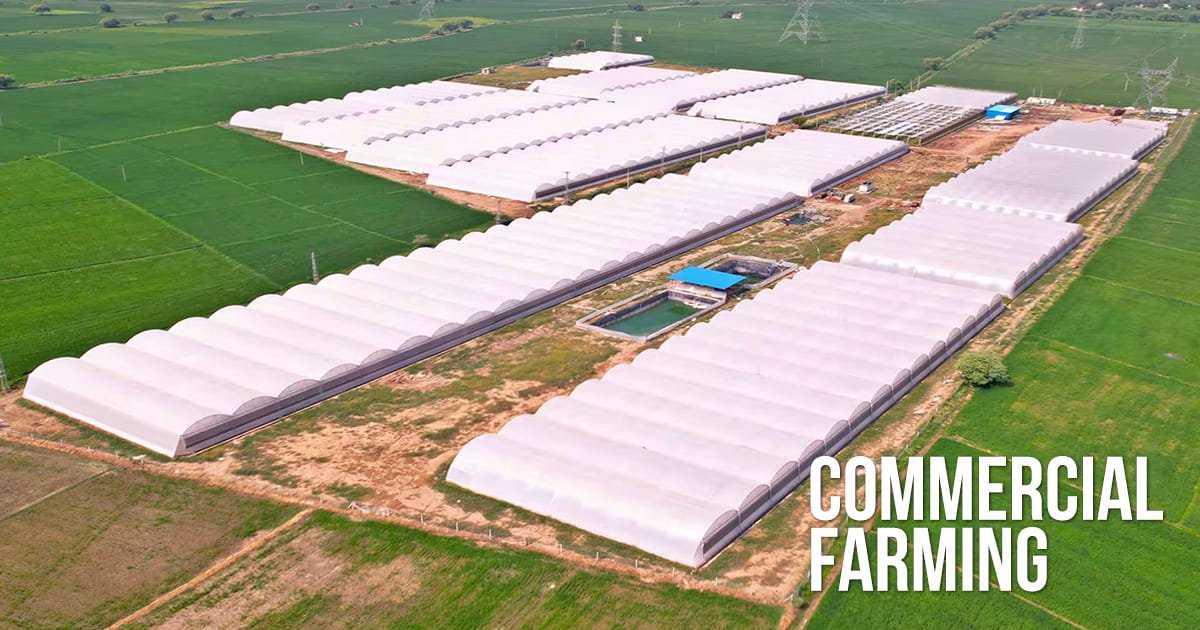
Agrifirst specializes in designing and installing polyhouse, greenhouse, and shade net structures across India, with projects spanning Uttar Pradesh, Maharashtra, Rajasthan, Karnataka, and the Northeast. Their expertise covers:
- Naturally Ventilated Polyhouses (NVP) — cost-effective, ideal for plains and semi-arid regions
- Fan-Pad Cooled Greenhouses — for high-value crops in warmer climates
- Shade Net Houses — for nurseries, floriculture, and leafy vegetables
- Drip & Fertigation Systems — precision water and nutrient management
- Subsidy Consultancy — end-to-end assistance with NHM, MIDH, and state schemes
For farmers like Balesh, the combination of high-quality infrastructure, agronomic knowledge, and subsidy navigation support is what makes Agrifirst stand apart.
Ready to Start Your Polyhouse Farming Journey?
Talk to our protected cultivation experts today. Free site assessment. Subsidy guidance included.
Get Free Consultation →Common Mistakes Balesh Avoided That Most First-Time Polyhouse Farmers Make
The reason Balesh's farm performs in the top quartile isn't just what he did — it's what he refused to do. After working closely with him through three production cycles, here are the costly mistakes that he deliberately stepped around:
- He didn't try to grow everything. Many first-time polyhouse farmers attempt 4–5 crops to "spread risk." The reality is that each crop has different temperature, irrigation, and fertigation needs. Mixing too many crops in one polyhouse leads to compromised conditions for all. Balesh picked two compatible high-margin crops and ran them tight.
- He didn't cheap out on seedlings. A common rookie move is sourcing seedlings from the lowest-cost nursery to save ₹1–2 per plant. Balesh paid for certified, virus-free seedlings from approved nurseries. The 5–8% upfront premium prevented the 20–30% yield loss that contaminated seedlings cause downstream.
- He didn't ignore the subsidy paperwork. Plenty of farmers build their polyhouse first and then "figure out the subsidy later." That order kills the application — NHM requires pre-approved DPRs. Balesh worked with Agrifirst's DPR team from day zero, which is why his subsidy actually disbursed instead of getting stuck in a perpetual queue.
- He didn't sell to the nearest buyer. Local mandis offer convenience but skim 25–35% off the gate price. Balesh invested time early to build direct relationships with two organised buyers — one supermarket chain and one regional processor. That single decision adds ₹4–5 lakh to his annual revenue.
These aren't unusual insights — they're the obvious ones once someone points them out. The reason they're worth listing is that 80% of new polyhouse farmers still make at least two of these mistakes in their first cycle.
5 Lessons from Balesh's Polyhouse Success Story
- Knowledge before investment: Balesh attended workshops and trained under Agrifirst before spending a single rupee. Understanding what you're building is as important as building it.
- Use government subsidies: The NHM subsidy reduced his capital burden by 50%. Every farmer investing in polyhouse infrastructure should explore available schemes in their state.
- Choose the right crop for your market: Capsicum and cucumber were chosen based on local demand analysis, not just personal preference. Crop selection is a business decision.
- Partner with experienced infrastructure providers: Cheap structures fail fast. Agrifirst's quality construction meant zero major repairs in three years — preserving Balesh's return on investment.
- Quality drives price: Polyhouse-grown produce fetches 30–40% more than open-field produce. The premium market is a separate game — and controlled cultivation lets you play it.
Conclusion: Your Story Could Be Next
Balesh Pratap Singh's journey from a ₹80,000/year conventional farmer to a ₹29 lakh/year polyhouse entrepreneur is not an exception. Across India, thousands of farmers are writing similar stories — in Maharashtra, Karnataka, Himachal Pradesh, and now increasingly across the Gangetic plains of UP and Bihar. Read more polyhouse farming success stories from farmers across India.
What it requires is the right information, the right infrastructure partner, and the willingness to take a calculated step forward. If you're a farmer curious about polyhouse farming — whether you have 0.5 acres or 5 acres — the economics work. The technology is proven. The government support is available.
And Agrifirst is here to walk with you, every step of the way.
"My message to every farmer is: don't be afraid of new technology. Get the right support, do the right thing, and your land will reward you beyond your imagination."




Share your thoughts