
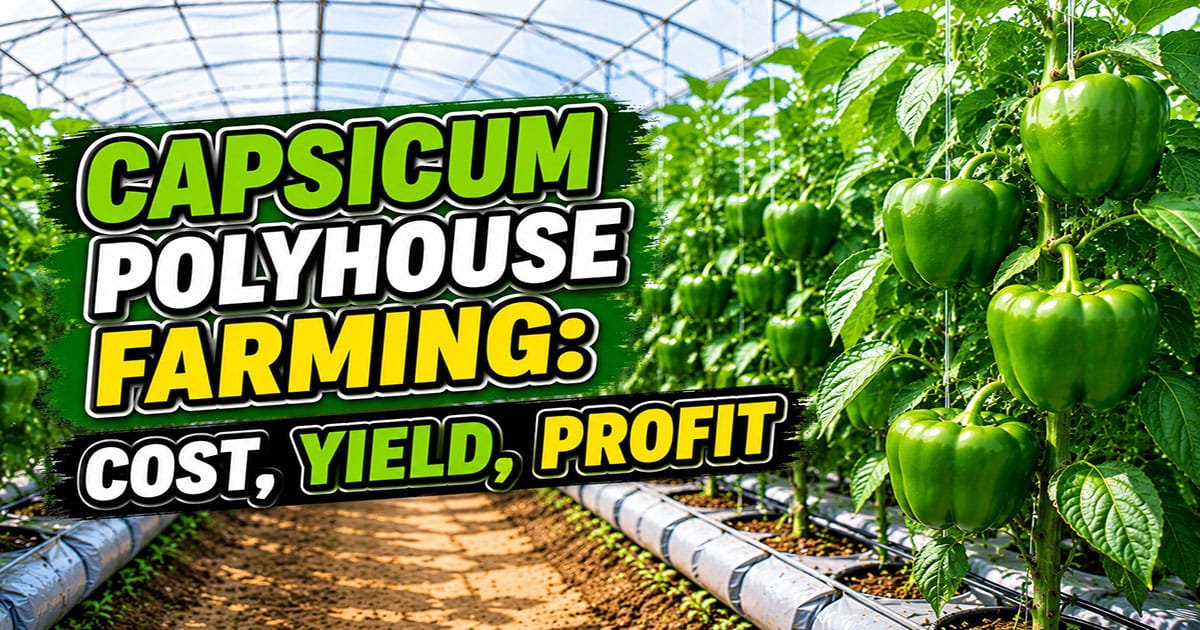
Economics of Capsicum Polyhouse Farming: Cost, Yield, Profit & NHB Subsidy Per Acre
Capsicum polyhouse farming has become one of the most successful protected cultivation models in India. With increasing demand from supermarkets, hotels, restaurants, and retail chains, farmers are increasingly investing in greenhouse and polyhouse solutions to improve productivity and produce premium-quality capsicum throughout the year.
Protected cultivation allows farmers to produce premium-quality capsicum throughout the year while minimizing losses caused by excessive rainfall, strong winds, temperature fluctuations, and pest infestations. By maintaining a controlled growing environment, polyhouses help achieve better fruit quality, higher productivity, and improved market prices.
This guide explains the complete economics of capsicum polyhouse farming, including setup cost, annual operating expenses, production potential, profitability, NHB subsidy benefits, crop requirements, and practical considerations for farmers planning to establish a commercial capsicum polyhouse.
Why Choose Capsicum for Polyhouse Farming?
As part of modern commercial polyhouse farming, capsicum offers one of the best combinations of market demand, crop value, and production efficiency.
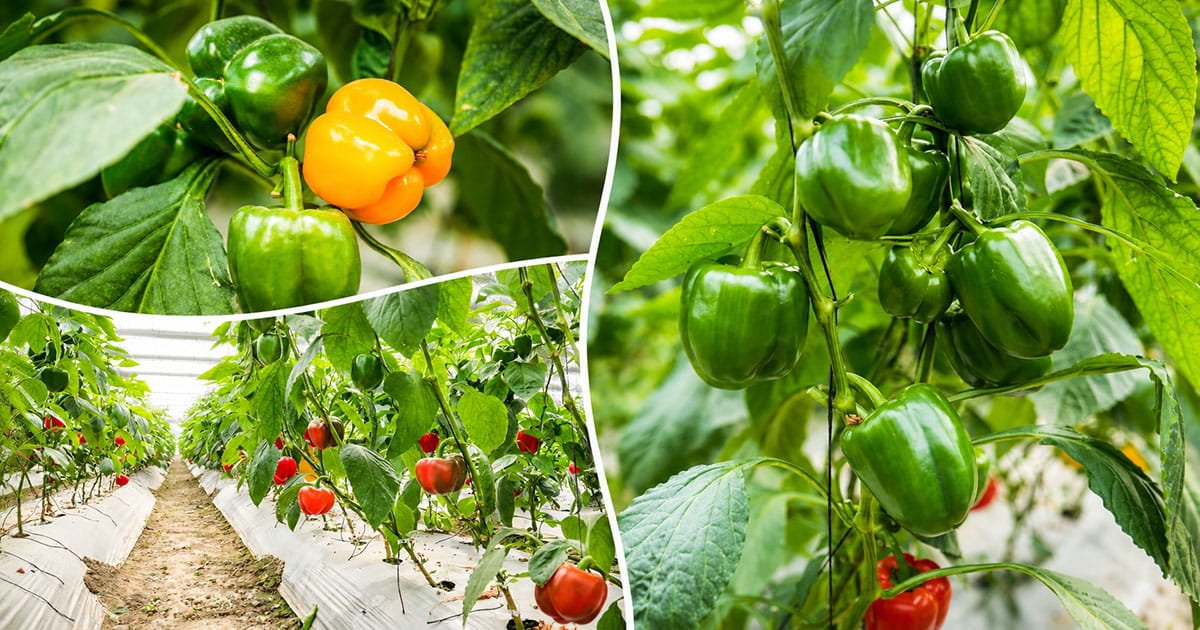
Capsicum can be cultivated under both polyhouse and net house structures. Colored capsicum (red, yellow, and orange) is generally preferred for commercial polyhouse projects because of its premium market demand and stronger profitability potential. Green capsicum is often recommended for net house cultivation because the lower project cost can result in a more favorable return on investment under many growing conditions.
- Higher yield per square meter
- Premium market prices
- Better fruit uniformity and appearance
- Extended harvesting period
- Reduced weather-related crop losses
- Efficient water and fertilizer utilization
- Improved pest and disease management
Because of these advantages, capsicum is among the most popular crops grown under naturally ventilated polyhouses across India.
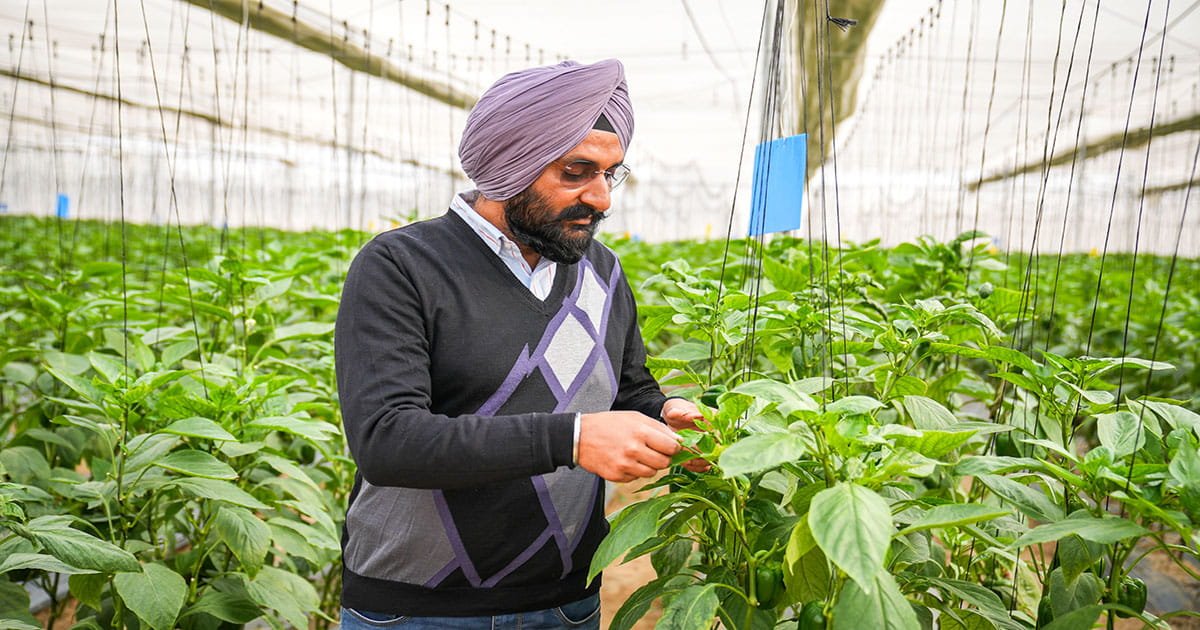
Why Protected Cultivation Is Preferred for Capsicum
Capsicum is highly responsive to environmental conditions. Excessive rainfall, strong winds, temperature fluctuations, and pest pressure can significantly affect fruit quality and yield in open-field cultivation. Protected cultivation helps create a more stable growing environment, allowing plants to maintain consistent growth and fruit development.
Capsicum Crop Requirements
Capsicum performs best under moderate climatic conditions. Successful production depends on maintaining optimal temperature, humidity, irrigation, nutrition, and crop management practices.
It is among the most preferred crops for protected cultivation due to its excellent response to controlled growing environments.
Climate Requirements
- Ideal temperature: 20°C to 27°C
- Relative humidity: 60% to 75%
- Good ventilation is essential
- Protection from frost and extreme heat is necessary
Soil Requirements
- Well-drained fertile soil
- Rich organic matter content
- pH range between 6.5 and 7.5
- Low salinity conditions
Suitable Elevation
Capsicum can be successfully cultivated up to elevations of approximately 1500 meters above sea level under suitable protected cultivation conditions.
Capsicum is sensitive to light frost and freezing temperatures. Well-drained soils rich in organic matter are preferred, and acidic soils may require liming to maintain suitable growing conditions.
Best States for Capsicum Polyhouse Farming in India
Commercial capsicum cultivation under protected structures is widely practiced across multiple states due to favorable climatic conditions and strong market demand.
- Karnataka
- Maharashtra
- Andhra Pradesh
- Tamil Nadu
- Madhya Pradesh
- Chhattisgarh
- Bihar
- Uttar Pradesh
- Himachal Pradesh
What Information Can Farmers Expect From a Capsicum Polyhouse Economics Study?
A capsicum polyhouse economics study helps farmers understand the complete financial and operational aspects of protected cultivation. It provides information related to setup cost, annual operating expenses, production potential, expected returns, crop requirements, and subsidy opportunities.
Understanding these parameters helps growers evaluate project feasibility and make informed decisions before investing in commercial capsicum cultivation under protected conditions.
Cost of One Acre Capsicum Polyhouse
The final project cost depends on structure specifications, location, and growing requirements. Farmers can explore different polyhouse structure options suitable for capsicum cultivation.
The initial investment in a polyhouse structure is one of the most important considerations. Modern naturally ventilated polyhouses are designed to support long-term commercial cultivation with proper ventilation, insect protection, trellising support, and crop management infrastructure.
| Project Particulars | Rate / Status |
|---|---|
| Size of the Unit | 1 Acre (4092 sq.m.) |
| Foundation Pipe | Included |
| Covering Plastic | Included |
| Secondary Layer Shade Net Manual Mechanism | Included |
| Shade Net for Top Vent | Included |
| Insect Net on Four Sides | Included |
| Bottom Skirting on Four Sides | Included |
| Manual Rollup Curtain | Included |
| Double Door Entry System (Aluminium Sliding Door with Buffer Zone) | Included |
| Trellising | Included |
| Structure Installation | Included |
| Ex-factory Price per Sq. Metre | ₹1060 /Sq. Metre |
| Ex-factory Price per Sq. Metre with GST @18% | ₹1250 /Sq. Metre |
| Total Investment Cost without subsidy | ₹ 51,15,000* |
| NHB Subsidy | ₹ 25,57,500* |
| Total Investment Cost with Subsidy | ₹25,57,500* |
Each structural component contributes to creating a protected growing environment. Insect nets help reduce pest entry, shade net systems assist in managing sunlight intensity, while roll-up curtains and ventilation systems support airflow management inside the structure.
The double-door entry system acts as an additional protective barrier, helping maintain crop hygiene and reducing the movement of insects into the cultivation area.
Important Note: While colored capsicum is commonly cultivated under polyhouse structures, the operating cost, production, pricing, and profitability estimates discussed below are based on a representative green capsicum cultivation model under protected conditions. In commercial practice, green capsicum is often recommended for net house cultivation because the lower project cost can result in a more favorable return on investment under many growing conditions.
Annual Operating Expenses in Green Capsicum Cultivation
The operating expense estimates and production assumptions discussed below are based on a representative green capsicum cultivation model under protected conditions.
| Particulars | Amount |
|---|---|
| Field Preparation | ₹65,000 |
| Labour | ₹2,64,000 |
| Seeds & Nursery | ₹35,000 |
| Fertilizers | ₹1,20,000 |
| Plant Protection | ₹55,000 |
| Other Expenses | ₹45,000 |
| Total Operating Expense | ₹5,84,000 |
Understanding Operating Expenses
Operating expenses represent the annual cost of managing a commercial capsicum crop inside a polyhouse. These costs include land preparation, labor, planting material, fertilizers, crop protection products, and various farm management expenses required throughout the production cycle.
Labor forms a significant component of operational expenditure because protected cultivation requires regular crop monitoring, pruning, training, harvesting, and maintenance activities.
Field preparation expenses include FYM application, tillage operations, basal fertilizer application, bed preparation, and other activities required before transplanting. These operations help create favorable growing conditions for healthy plant establishment and development.
The seed and nursery component covers approximately 12,000 plants required for one acre of green capsicum cultivation. Depending on the variety and nursery source, seed and nursery expenses generally range between ₹30,000 and ₹35,000 per acre.
Green capsicum generally has a shorter crop cycle compared with colored capsicum. Therefore, fertilizer requirements are comparatively lower, resulting in an estimated fertilizer expenditure of approximately ₹1.20 lakh per acre.
Production Potential of Green Capsicum Under Protected Cultivation
Under proper agronomic management, a one-acre protected cultivation unit can accommodate approximately 12,000 to 14,000 plants depending on spacing and variety.
Green Capsicum Yield Summary Per Acre
| Particular | Value |
|---|---|
| Plant Population | 12,000–14,000 Plants |
| Average Yield Per Plant | 2.5–3.0 Kg |
| Estimated Total Production | 30–40 Tonnes (30,000–40,000 Kg) |
| Average Selling Price | ₹25–30/Kg |
Factors Affecting Green Capsicum Yield Under Protected Cultivation
The productivity of capsicum under protected cultivation depends on variety selection, climate management, irrigation scheduling, nutrient availability, and crop health.
Regular crop monitoring and timely management practices help maintain fruit quality and production throughout the growing cycle.
Production Per Plant
Under suitable growing conditions, green capsicum plants can produce approximately 2.5 to 3.0 kilograms per plant. Actual production varies depending on variety, crop management practices, climate conditions, and plant health.
Market Demand for Capsicum in India
Capsicum is widely consumed across India through retail markets, supermarkets, hotels, restaurants, and food processing channels. Demand for high-quality produce continues to increase as consumers prefer uniform, attractive, and fresh vegetables.
Protected cultivation helps farmers produce marketable capsicum with better appearance and quality standards, supporting access to premium markets and organized retail supply chains.
Indicative Economics and Profitability Per Acre
| Particulars | Value |
|---|---|
| Total Production | 30–40 Tonnes (30,000–40,000 Kg) |
| Average Selling Price | ₹25–30/Kg |
| Operating Expenses | ₹5,84,000 |
Profitability Considerations for Green Capsicum
Actual return on investment and payback period depend on production levels, market prices, operating expenses, and overall crop management. Since green capsicum prices can vary significantly across markets and seasons, farmers should conduct a detailed financial assessment based on local conditions before estimating project profitability.
Actual return on investment may vary depending on crop performance, market prices, operating expenses, climate conditions, and farm management practices. Consistent production and effective marketing play an important role in improving project profitability.
Net Return Calculation for Green Capsicum Cultivation
Based on an average production of 40 tonnes (40,000 kg) per acre and an average selling price of ₹30 per kg, the estimated gross return from one acre of green capsicum cultivation under protected conditions is approximately ₹12,00,000.
| Particulars | Amount |
|---|---|
| Gross Return (40,000 kg × ₹30/kg) | ₹12,00,000 |
| Operating Expense | ₹5,84,000 |
| Net Return | ₹6,16,000 |
The estimated net return is calculated after deducting the annual operating expense of ₹5,84,000 from the gross return of ₹12,00,000, resulting in an estimated net return of ₹6,16,000 per acre. Actual returns may vary depending on yield, market prices, climate conditions, and crop management practices.
Understanding Yield and Profitability
Net returns from capsicum cultivation are influenced by both production levels and selling prices. Consistent crop management practices, proper nutrition, and effective pest management contribute to maintaining yield and fruit quality throughout the harvesting period.
Since production and market conditions can vary across seasons and locations, actual returns may differ from projected estimates. Careful planning and continuous crop monitoring remain important factors for achieving profitable cultivation outcomes.
Regional Profitability Considerations
Capsicum production is generally higher in central and southern India compared with northern regions. However, average selling prices are often higher in North India. As a result, the return on investment per acre tends to remain relatively balanced across different parts of the country.
Factors Influencing Net Returns
Net returns from capsicum cultivation depend on production levels, market prices, operating expenses, climatic conditions, and crop management practices. Variations in any of these factors may influence overall profitability.
Role of Market Access in Profitability
While production plays a major role in determining farm income, market access is equally important in capsicum cultivation. Farmers located near wholesale markets, retail chains, supermarkets, hotels, and food service businesses may benefit from faster produce movement and reduced transportation costs.
Efficient post-harvest handling and timely marketing can help maintain product quality and improve selling opportunities. Understanding local market demand before establishing a polyhouse project can contribute to better long-term economic outcomes.
NHB Subsidy for Capsicum Polyhouse Projects
Farmers planning a capsicum polyhouse project can benefit from government-supported subsidy programs. Financial assistance is available through schemes operated by the National Horticulture Board (NHB), Mission for Integrated Development of Horticulture (MIDH), and various state horticulture departments. These schemes help reduce the initial investment burden and encourage the adoption of protected cultivation technologies.
To understand subsidy eligibility, documentation requirements, and application procedures, farmers can explore AgriFirst's NHB subsidy guides and resources.
Advantages of Protected Cultivation for Capsicum
Protected cultivation helps growers maintain better control over temperature, humidity, irrigation, and crop protection. Compared with open-field farming, polyhouses support improved fruit quality, higher productivity, efficient resource utilization, and reduced weather-related risks.
Why Farmers Choose AgriFirst Polyhouse Solutions
- Customized polyhouse design and engineering
- Complete project execution support
- Agronomy guidance from crop experts
- Assistance with subsidy documentation
- Technical support throughout cultivation
- Focus on maximizing productivity and profitability
AgriFirst has supported farmers across India with modern protected cultivation projects. Explore our success stories to learn how growers are improving productivity, crop quality, and profitability through scientifically designed polyhouse systems.
Is Capsicum Polyhouse Farming a Profitable Investment?
Capsicum continues to be one of the most commercially important vegetable crops grown under protected cultivation in India. The combination of controlled growing conditions, improved fruit quality, and higher production potential makes it a preferred choice for many growers.
When supported by proper planning, suitable infrastructure, scientific crop management, and market access, capsicum polyhouse cultivation offers an opportunity to improve farm productivity and operational efficiency. Farmers should evaluate local conditions, investment requirements, and available support systems before initiating a commercial project.
Planning a Capsicum Polyhouse Project?
If you are planning to start capsicum cultivation under a polyhouse, the right structure design, agronomy guidance, and project planning can significantly influence long-term productivity and profitability.
AgriFirst provides complete support for protected cultivation projects, including polyhouse design, project execution, agronomy assistance, and guidance on subsidy-related processes.
Contact AgriFirst to discuss your project requirements and receive expert guidance for establishing a commercially viable capsicum polyhouse.
Disclaimer: The costs, production figures, subsidy estimates, revenue projections, and net return calculations provided in this article are indicative and based on specific assumptions and conditions. Actual results may vary depending on location, climate, variety selection, crop management practices, market prices, input costs, and applicable government guidelines. Farmers are advised to conduct a detailed project assessment and consult experts before making investment decisions.
The figures presented in this article are based on protected cultivation project assessments, industry practices, and commercial farming estimates. Actual performance may vary depending on location, variety, crop management, and market conditions.
Conclusion
Capsicum polyhouse farming continues to be one of the most promising protected cultivation opportunities in India. With proper planning, scientific crop management, quality planting material, and market access, farmers can generate attractive returns while reducing risks associated with conventional farming. A well-designed polyhouse combined with professional agronomy support can help growers achieve sustainable and profitable capsicum production year after year.
Apart from greenhouse and polyhouse projects, AgriFirst also offers shade net structures and hydroponic farming systems for farmers looking to adopt advanced cultivation technologies and improve resource efficiency.


Share your thoughts